Geneva, 29 november 2021 – In 2011, a long-term partnership was established between Interpeace –an international peacebuilding organisation– and Mirabaud. At a time when an unprecedented global movement is making its mark on sustainable finance, efforts for peace must also be a central focus. Peace is essential for sustainable development and promotes stability, growth and prosperity in countries. Without peace, there can be no economic growth and without inclusive economic growth, there can be no lasting peace.
The number of conflict zones is ever increasing. At present, they concern some 57 countries considered as fragile, i.e. 1.8 billion people in 2021 (2.3 billion in 2030), the equivalent of 85% of the world’s poorest populations. Nearly one third of the world’s population is experiencing situations of conflict and therefore poverty and economic hardship.
“All too often, fragility and recurrent conflicts prevent any sustained development progress in these countries. What is worse, they discourage investment. It is essential to be able to improve the connection between peace work (Sustainable Development Goal 16) and private investment,” says Interpeace President Scott Weber.
It was with this in mind that, a decade ago, Mirabaud and Interpeace built an innovative partnership by setting up a sharing fund investing in emerging countries. “These countries may have the potential for significant growth, but this can be held back or even prevented by recurrent conflicts. It therefore seemed a natural step for us to enter into partnership with an organisation such as Interpeace, which supports endogenous peace processes and thus promotes the conditions for sustainable peace and stability,” explains Lionel Aeschlimann, CEO of Mirabaud Asset Management.
“This strategic support from Mirabaud and its clients has enabled us to provide a concrete response to situations of vulnerability and to be more reactive when needed,” says Scott Weber.
Mirabaud allows its clients to direct part of the profits to Interpeace via a sharing fund, while the asset manager also contributes a portion of its fees.
“We are proud to have supported Interpeace over the last 10 years. This partnership enables us to unite our clients and the Mirabaud Group around a common approach,” adds Lionel Aeschlimann. “Long-term support is essential for any peace process.’’
“This fund structure combining performance and sustainability offers easy access to the cause of peacebuilding for investors wishing to achieve this objective,” summarises Lionel Aeschlimann. “Geneva, with its financial and international expertise, can play a key role in meeting this challenge,” he adds.
Ten years after the formation of this partnership, a movement combining finance and sustainability is now well established, as evidenced by the Building Bridges Conference to be held in Geneva from 29 November to 2 December. “With the creation of this mechanism 10 years ago, Mirabaud demonstrated a real vision of how finance can support peace efforts and we are pleased to be able to build on this,” explains Scott Weber. Interpeace will unveil the outline of its ‘Finance for Peace’ initiative at a panel discussion on 1 December as part of Building Bridges. This project aims to further bridge the worlds of finance, development and peace and will be a platform for collaboration, action and research to develop new financial products for peace. The objective is to contribute to a truly global peace investment market.
Founded in 1994 by the UN, Interpeace is an international peacebuilding organisation based in Geneva. It supports endogenous peace processes in more than 20 contexts and assists the international community and, in particular, the United Nations in strengthening their intervention strategies in fragile contexts.
Its purpose is to support communities to resolve their own conflicts and achieve sustainable peace, without imposing external solutions on the affected countries.
Interpeace
Interpeace is an international peacebuilding organisation. With more than 25 years of experience, it carries peacebuilding processes and supports the international community particular the United Nations in their peace efforts worldwide. Interpeace was officially recognized as an international organization by the Swiss Federal Council in 2018. Interpeace is headquartered in Geneva, Switzerland, and is present in more than 20 fragile contexts around the world.
For more information, please visit our website: www.interpeace.org
Mirabaud Asset Management
With offices in Geneva, Zurich, Luxembourg, Paris, London and Madrid the Mirabaud Group’s Asset Management division focuses on investment management and advisory services.
Its investment capabilities include:
Across all investments Mirabaud Asset management applies a common philosophy of an active, high conviction approach to generating long-term risk adjusted returns. A focus on managing risk and a commitment towards environmental, social and corporate governance principles are important constituents of Mirabaud’s heritage.
For more information, please visit our website: www.mirabaud-am.com
The Mirabaud Group
The Mirabaud Group was founded in Geneva in 1819. With its four core values of Independence, Conviction, Responsibility and Passion, it has grown over the years into an international group offering its clients personalised financial services and advice in various areas of activity Its expertise lies in Wealth Management (portfolio management, investment advice and services for independent asset managers), Asset Management (institutional management, fund management and distribution) and highly specialised bespoke services (equity research, corporate advisory and intermediation).
Mirabaud has always been strongly committed to responsibility and sustainability. This is reflected in its interactions with clients, employees and society as a whole. As a signatory of the United Nations Principles for Responsible Investment (PRI) since 2010, Mirabaud has the highest rating in this area thanks to its governance and its committed global strategy.
The Group employs around 700 staff and has offices in Switzerland (Geneva, Basel and Zurich), Europe (London, Luxembourg, Paris, Madrid, Barcelona, Valencia and Seville) and the rest of the world (Montreal, Dubai, Abu Dhabi, Montevideo and São Paulo).
For more information, please visit our website: www.mirabaud-am.com
Marionna Wegenstein
M. +41 79 410 99 49
mirabaud@dynamicsgroup.ch
Wegenstein Communication,
Partner der Dynamics Group
Luvini Ranasinghe
T. +41 79 475 64 95
ranasinghe@interpeace.org
Interpeace
Maison de la Paix
2E Chemin Eugène-Rigot
1202 Geneva, Switzerland
Lydia Albrecht
T. +41 58 816 27 79
F. +41 58 816 33 90
lydia.albrecht@mirabaud.com
MIRABAUD & Cie AG
Boulevard Georges-Favon 29
1204 Genf, Schweiz
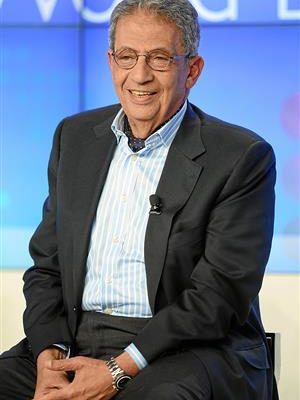
GENEVA, 25 NOVEMBER 2021 – Interpeace is pleased to announce the appointment of Amre Moussa as the incoming Chair of its Governing Board. The eminent statesman will succeed Monica McWilliams, who concluded her second four-year term with the Board in mid-2021.
“Amre Moussa’s regional experience, deep wisdom, and inspiring vision will elevate Interpeace’s impact during a period of growth for the organization. His leadership will be critical to our ability to build peace and strengthen resilience in an increasingly polarised world,” said Interpeace President Scott Weber.
“Rethinking how peace is built and sustained demands the kind of principled pragmatism that Amre Moussa has demonstrated over the course of his accomplished career. I am excited to welcome Amre to Interpeace as we harness the resilience of communities from Rwanda to Ukraine to Mali for enhanced peace and development.”
Amre Moussa served as Secretary-General of the League of Arab States for a decade. It is in this capacity that he led efforts to build regional cohesion, resolve the Arab-Israeli conflict, and lift the siege of Gaza. Amre Moussa worked to strengthen dialogue and peace efforts on a cultural and political level with the Holy See, affecting communities in Iraq, Lebanon, and elsewhere in the Arab world.
He is currently a member of the African Union (AU) Panel of the Wise, advising on issues of conflict prevention and resolution for the AU’s Peace and Security Council.
“Through my interactions with civil society and governments, I have seen how peace can transform societies. In many contexts, trust in institutions and the social contract has eroded, giving rise to new conflicts and preventing the resolution of longstanding ones,” said Amre Moussa.
“Interpeace is doing important work to help communities resolve today’s complex and multidimensional conflicts themselves. I look forward to joining the organization in its mission to strengthen the international system’s contributions to peace.”
Amre Moussa is a former member of the United Nation's High-Level Panel on Threats, Challenges, and Change for international peace and security, established by UN Secretary-General Kofi Annan.
He held leading positions in the Foreign Ministry of his country between 1958 and 1972 including in Egypt’s Embassy in Switzerland and its Mission to the United Nations. He then served as Deputy Permanent Representative to the United Nations in New York, Ambassador to India, Permanent Representative to the United Nations, and, later, Foreign Minister from 1991 to 2001.
Having pursued peace at the highest levels of decision making and in some of the most contested contexts, Mr. Moussa’s arrival is expected to advance Interpeace’s mission worldwide significantly.
For more information:
Luvini Ranasinghe
Global Communications Manager
T +41 22 404 59 22
M +41 79 475 64 95
Continued violence in some communities in northern Kenya has often torn societies apart, with attacks resulting in the deaths of community members, damage to property, injuries, and displacements. In northern Kenya, Interpeace and the National Cohesion and Integration Commission (NCIC) have facilitated the establishment of local peacebuilding structures through which communities have often shown incredible resilience to rise above their differences and break the cycle of violence.
In Banisa, Mandera County, along the Kenya-Ethiopia border, the dialogue spaces have been used by local communities to collaborate, manage conflicts and to reconcile their differences.
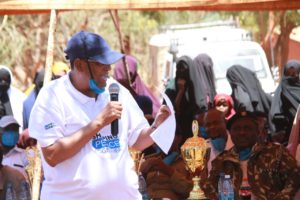
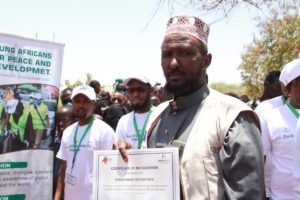
“Peace can only be sustained from within these communities. That is why we put emphasis on strengthening the resilience of local peacebuilding spaces, so that they can sustain peace after our project ends,” explained Hassan Ismail, Interpeace Kenya Country Representative.
The dialogue spaces in Banisa were established after 28 people died in a series of attacks and retaliatory attacks that also left thousands of others displaced in October 2019. The conflict was resolved through a series of inter-community dialogues that concluded in a peace agreement.
The community peacebuilding structures consist of ceasefire monitoring committees (CMCs), working groups, peace actors’ forum and village dialogue space committees that link the various conflict corridors. All these structures are coordinated and supported by the local peacebuilding teams. Members of the ceasefire committee work with communities to disarm local militias, ensure that displaced persons return home, initiate and facilitate dialogue, and enhance social cohesion.
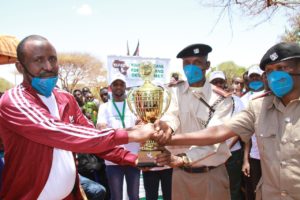
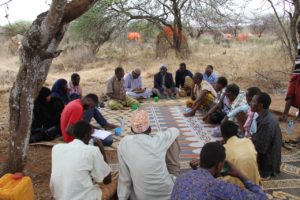
“The effective implementation of agreements depends on how we work as a team, our clan background notwithstanding, we will always forge forward,” said Mohamed Yussuf, a member of the ceasefire monitoring committee.
Members of the committee have been trained to analyse conflict, facilitate dialogue, share conflict early warning for early response and to resolve conflicts within their communities before they spiral out of control. Since the establishment of the dialogue spaces, violent acts of retaliation have reduced significantly. These local structures have also responded to six major violent incidents involving 14 deaths.
Through the spaces, trust has been restored between some communities in Mandera and the culture of peace and reconciliation nurtured – hence addressing some structural issues that often trigger conflict in the communities without the support of external peace actors.
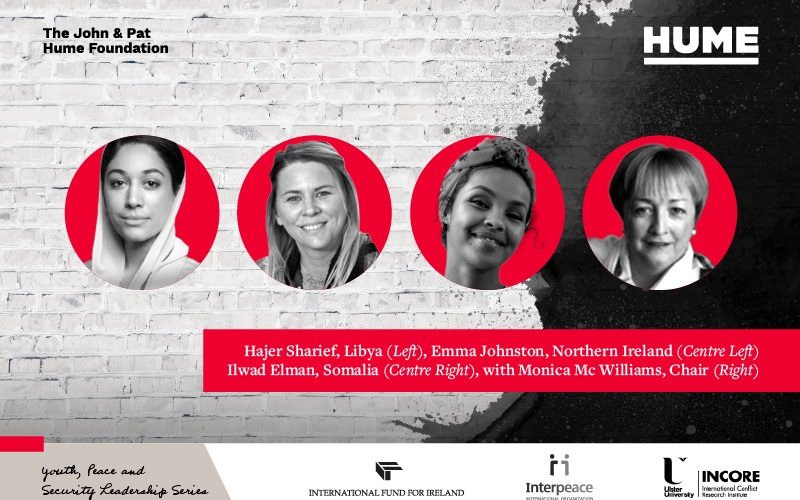
On Friday 1 October 2021, Monica Mc Williams who is Emeritus Professor at Ulster University, Board member of the John and Pat Hume Foundation and former Chairperson of Interpeace, will chair Fire in the Belly
Fire in the Belly will feature lessons from young women peacebuilders from Somalia, Libya and Northern Ireland on inspiring leaders for peaceful change.
It takes place online on Friday 1 October 2021 at 3:30pm and is free of charge and everyone with an interest is welcome to join. Pat Hume who was recently described by Monica Mc Williams ‘as the woman who never gave up’ is the inspiration behind Fire in the Belly, the third event planned in the Youth, Peace and Security Leadership Seminar Series.
The seminar series is a partnership between Ulster University (INCORE & TJI), The John and Pat Hume Foundation, John Hume and Thomas P. O’Neill Chair in Peace, International Fund for Ireland (IFI), and Interpeace.
Tim Attwood, Secretary of the John & Pat Hume Foundation, said:
“It is important to acknowledge and highlight the positive work of young women and men working on peace at home and globally. The late Pat Hume had to scale so many obstacles working for peaceful change during times of great personal and political risk. She was described as ‘the woman who never gave up’. We must inspire a new leadership of young people in peacebuilding who will also never give up.”
Speaking about the importance of this series, Graeme Simpson, the Senior Representative (NY) & Peacebuilding Adviser at Interpeace, said:
"The global Youth, Peace and Security (YPS) agenda has recognized that instead of treating young people as a threat, it is imperative to invest in the resilience, resourcefulness, and innovation of young peacebuilders. Interpeace believes that little is more important in amplifying the voices of young peacebuilders themselves, than the powerful leadership of young women, connecting with each other across the globe."
Ahead of the event on Friday, Hajer Sharief, the Libyan peace and human rights activist, said:
"Peace should be treated as a "public good" of which everyone has the right to build, shape and make. Therefore, the inclusion of women and youth in peace processes is not a matter of ticking a box, it’s a matter of providing people with the opportunity to practice their right to shape their own lives and societies".
Emma Johnston of Youth Action Northern Ireland and UU Alumni, said:
“The Youth, Peace and Security Seminar Series frames critical conversations which enable global youth leaders to pool our resources and work collectively with young women to breathe positive energy into their lives. Young women need role models; women who they can up look to. I am looking forward to coming together to ignite that important fire in the belly.”
Paddy Harte, Chairman of the International Fund for Ireland, said:
“Fire in the Belly is an excellent opportunity for a wider audience to understand the influential role that women play within peace building. The Youth, Peace and Security Series complements the IFI’s ethos and also enhances our partnerships with other organisations. Engaging young people to offer them the best opportunities in life so they can develop, grow and give back to their own communities is a core focus of our work.”
Professor Brandon Hamber, John Hume and Thomas P. O’Neill Chair in Peace at Ulster University, said
“A core focus of the John Hume and Thomas P. O'Neill Chair in peace is to support the next generation of peacebuilders. I can think of no better way to do this than exchange practical lessons between young women peacebuilders form around the globe. They have much to share and teach all of us.”
Notes to Editor
Fire in the Belly is open to everyone with an interest and free to join.
This is the third seminar in the new Youth, Peace and Security Leadership Seminar Series explores the positive contribution of youth to peace. Every 6-8 weeks, a free online platform is created for young leaders to share their experience from around the world.
It takes place Friday 1 October 2021 at 3:30pm – 5pm. For further information and to be directed to Eventbrite for booking, visit:
Speakers
Speaker biographies:
Monica McWilliams
Monica McWilliams is a signatory to the Good Friday Agreement and was involved as a lead negotiator in the multi-party talks leading to the agreement in 1998 on behalf of the Women's Coalition which she co-founded two years earli She is Emeritus Professor of Women’s Studies at the Transitional Justice Institute at Ulster University and former Chief Commissioner of the Northern Ireland Human Rights Commission. She was an elected member of the Northern Ireland Legislative Assembly from 1998-2003 and currently serves on the Independent Reporting Commission, overseeing measures on the disbandment of paramilitary organisations in Northern Ireland.Monica is a former Chairperson of Interpeace, Board member of The John & Pat Hume Foundation and author of a range of publications on domestic violence, human security and the role of women in peace processes. Her memoir Stand Up, Speak Out will be published by Blackstaff in October 2021.
Hajer Sharief
Hajer Sharief is a Libyan peace and human rights activist. She co-leads the work of the Together We Build It (TWBI) organization in Libya focusing on women and youth peace and security. She is a member of the Extremely Together young leaders, an initiative by Kofi Annan and the Kofi Annan Foundation. In 2020, Forbes named Sharief as one of Africa's Most 50 Powerful Women. And she was listed by Avanec media among the 100 Most Influential African Women for 2020. In 2017, Hajer Sharief was awarded the Student Peace Prize from Isfit.
Ilwad Elman
Ilwad Elman is a young female leader at the forefront of the Somali peace process, and a global authority on peace and security. After the assassination of her father, a prominent Somali peace activist, Ilwad and her family became refugees, eventually finding asylum in Canada. Aged 19, she felt the responsibility to return with her mother to a Somalia still steeped in violent conflict, where they founded the Elman Peace Centre. At just 20, she co-founded Somalia’s first rape crisis center. Since, Ilwad has become a champion of building peace through giving all those impacted by conflict — particularly women and girls — a seat at the table. Beyond her duties at the Elman Peace Centre; Ilwad is an advocate for the Kofi Annan Foundation and was a mentee of His excellency, the late Kofi Annan for three years. Through the Elman Peace Centre, Ilwad has created a methodology for community-based peace building in contexts of ongoing conflict that is now being exported to conflicts across Africa.It has led to her becoming a UN expert advisor on Peace & Security to two UN Secretary Generals and two year stint as the youngest ever board member of the UN Peace Building Fund, advising the UN Secretary General directly on fragile and conflict affected states globally.
Emma Johnston
Emma has been involved in youth work from a young age and participates in a range of youth activities and programmes in her local community. A worker within the Equality work with young women’s team of YouthAction Northern Ireland, Emma is committed and passionate about challenging the systems which continue to limit young women’s opportunities. Emma is a representative of young women’s voices on Northern Ireland Women’s European Platform and the UK Joint Committee for women with a seat on the European Women’s Lobby attending conferences at national and international level. She sits on the Irish NAP for Women Peace and Security. She was a member of the Foyle Pride Committee for four years organising a week of pride activities in Derry and LGBT Awareness week. Emma is a graduate from Ulster University at Magee in Derry where she undertook a Bsc Honours in Community Youth Work.
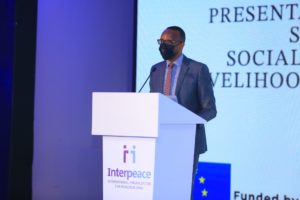
Studies show a high prevalence of mental health disorders in Rwanda. This imprint of the 1994 genocide against the Tutsi has made reconciliation and societal healing difficult. During a hybrid conference in the capital Kigali, on 2 September 2021, Interpeace and partners presented findings from baseline research carried out on mental health and societal healing in Bugesera District.
The conference was organised by Interpeace, in partnership with the National Unity and Reconciliation Commission (NURC) and Prison Fellowship Rwanda (PFR). It was supported by the European Union (EU) through its embassy in Rwanda.
During the event, participants also discussed the development of several protocols, informed by this baseline survey, to assess ongoing efforts and intervene on issues related to mental health, social cohesion, and sustainable livelihoods in Rwanda.
Since the genocide against the Tutsi, Rwanda has gone through 27 years of sustained development and growth. However, the country continues to grapple with significant mental health challenges. A considerable proportion of the Rwandan population lives with trauma linked to the genocide against the Tutsi.
“My mother is always lonely. When I ask her a question about what happened during the genocide, she immediately goes to the room and cries, and I feel sad because there is nothing I can do to help her feel better,” said one participant of the baseline study.
This is exacerbated by psychological and socioeconomic distress which have contributed to disrupt social cohesion. These prevailing mental health conditions have made it difficult to rebuild trust and reconcile people in Rwanda.
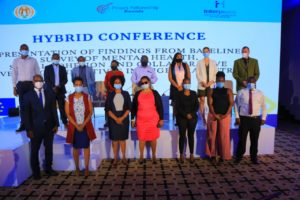
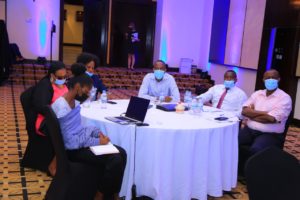
“Bugesera has suffered a lot from the genocide against the Tutsi. Traumatised people have difficulties to forgive and trust each other, and to embrace development and sustainable livelihoods,” said Richard Mutabazi, Mayor of Bugesera District.
However, the government of Rwanda and local civil society organisations have already made significant investment and progress towards trauma healing, social cohesion and improving livelihoods. To support these ongoing efforts, the National Unity and Reconciliation Commission, Prison Fellowship Rwanda and Interpeace started implementing the pilot phase of a societal healing programme in Bugesera District, which was the hardest hit by the genocide against the Tutsi. This baseline study on mental health and societal healing was part of this programme, launched in October 2020.
“We wanted to assess the current state of communities in Bugesera District, in relation to mental health, social cohesion and collaborative livelihoods, and then use the data as a basis to develop intervention protocols for the district and beyond,” explained Frank Kayitare, Interpeace Rwanda and Great Lakes Representative. He added: “We have gained invaluable input from government and non-governmental organisations. These inputs have made our programme more responsive; allowing for a potentially more resilient outcome.”
The presentation of this study’s results at the conference, on 2 September, marked the completion of the first stage of this pilot programme, known as ‘’Reinforcing community capacity for social cohesion and reconciliation through societal trauma healing in Bugesera District’’.
“We are very happy to see this project come to fruition after multiple discussions that started on this very important topic between Interpeace, the government, the EU and other partners over a year ago,” said H.E Nicola Bellomo, EU Ambassador in Rwanda.
The mental health challenge in Rwanda is multidimensional. Lack of remorse and forgiveness, impunity, and poverty were all cited in the research as factors that underlie mistrust between social groups. Another important aspect revealed by the study was the challenge to successful reintegration of convicted genocide perpetrators who have completed their prison term. Specifically, it was found that reintegration is very often an extremely challenging experience, for the former perpetrators but also for the communities receiving them. Issues of social stigma, rejection by the family, and inability to sustain livelihoods were most frequently reported among released ex-prisoners. These social challenges faced by ex-prisoners compound problems caused by a long period of incarceration, which include loss of social and professional identity, erosion of family relationships and emotional expression, and loss of hope in the future.
“Challenges at community level are not only one-dimensional and require collaborative effort. What is happening in Rwanda is a ground-breaking and shining example. We should think of scalability of these initiatives for a better outcome,”, said Dr Theo Hollander, Senior Regional Representative for Eastern and Central Africa at Interpeace.

In terms of livelihoods, the baseline survey revealed evidence of economic hardship. People struggle to survive as well as they can in adverse circumstances. A key challenge that emerged from the study is low agricultural production contributing to food insecurity. Reliance on rain-fed farming, insufficient access to irrigable land, limited use of fertilizers, and limited ownership of livestock, all contribute to this challenge. Residents inevitably rely on markets to supplement their food supplies, which in turn pushes young people into menial labour roles in order to generate the required cashflow, reducing their availability to participate in education and training. Vocational skills were found to be lacking in the district, with the vast majority of respondents reporting that their only vocational skill is farming with basic tools.
“Our goal in Rwanda is to develop comprehensive interventions, blend Rwandan home-grown solutions with international best practices and utilize multiple types of evidence to improve mental health,” said Ntwali Jean Paul, Deputy Executive Director of Prison Fellowship Rwanda.
The study additionally assessed gender and youth perspectives and dynamics in terms of mental health, family relations, prisoner reintegration, and livelihoods. The study found that women in Bugesera district were deeply affected by the genocide, through various direct and indirect pathways. Regarding mental health, the study found that more women than men reported problems with anxiety and depression. With respect to the inter-generational transmission of genocide legacies, the study identified two major challenges for young people; the first is growing up in a family in which the parents suffer from extensive psychosocial issues due to their traumatic experiences, to the extent that it undermines their capacity as parents. The second is the difficulty for parents to discuss events and experiences that often cause their children to feel confused, angry, or insecure.
“Mental health is crucial to advance social cohesion in Rwanda. Teams from Interpeace Rwanda, the National Unity and Reconciliation Commission, the Ministry of Health and Prison Fellowship Rwanda have been supporting Rwandans and the government to address these mental health challenges and trauma and we are committed to do more with our partners,” said Scott Weber, President of Interpeace.
The results of the baseline survey have informed the development of several new protocols for assessment and intervention, which will guide further efforts related to mental health, social cohesion, and sustainable livelihoods in Rwanda. The set of protocols included a holistic mental health and psychosocial care intervention combining Rwandan home-grown solutions with international best practices. Specifically, the screening protocols aimed to assess the community population and assign participants in interventions, based on their individualized needs. Among other developed protocols, there is a resilience-oriented therapy protocol and socioemotional skills curriculum for mental health care; multi-family healing space and adaptations on the sociotherapy protocols for social cohesion; prisoners’ risk and resilience assessment and prisoners’ rehabilitation protocols and reintegration roadmap; as well as collaborative livelihoods protocol to guide the community-based enterprises development.
Please follow this link and listen to the conference recording: https://spoti.fi/3zOnMod
Our societal healing programme in Rwanda enhances capacities of communities through an innovative and holistic approach to expand investment in mental health, address trauma and advance social cohesion. The programme is funded by the EU through its instrument contributing to stability and peace (IcSP).
La Côte d’Ivoire est entrée en 2020 dans un nouveau cycle électoral marqué par des confrontations intra- et intercommunautaires. Alors que les trois quarts de la population ont moins de 35 ans, les jeunes sont souvent stigmatisés et perçus comme étant responsables ou associés à de la violence politique. Pour changer cette vision et contribuer à la mise en œuvre de l’agenda Jeunes, paix et sécurité, Interpeace et son partenaire Indigo Côte d’Ivoire ont lancé un projet visant à améliorer leur participation en tant qu’acteurs et leaders dans la consolidation de la paix et la prévention des violences politiques. Le Livre blanc rassemblant les résultats et bonnes pratiques tirées de cette action a été présenté le 7 septembre 2021 à Abidjan.
En période électorale, un marketing politique polarisant et manipulateur des identités est fréquemment employé par les acteurs politiques ivoiriens de tous bords pour mobiliser leurs électeurs. Cela génère des tensions entre groupes ethniques et religieux, et entretient un climat de défiance et de contestation des résultats électoraux qui peuvent dégénérer en violences intercommunautaires. En 2020, près de 80 personnes ont ainsi trouvé la mort à travers le pays dans des affrontements liés aux élections présidentielles. La participation des jeunes à ces conflits est souvent montrée du doigt par les acteurs locaux, nationaux et internationaux, qui les désignent comme des acteurs « à risque » vulnérables et facilement manipulables. Ces discours ont pour effet de stigmatiser et marginaliser la majorité silencieuse des jeunes hommes et femmes qui restent en dehors des processus de violence, et de déprécier les efforts de celles et ceux qui s’engagent activement au quotidien pour la paix et la cohésion sociale.
C’est également le constat fait par la résolution historique 2250 du Conseil de sécurité des Nations Unies en 2015, qui appelait tous les acteurs concernés à augmenter la représentation et la participation inclusive, effective et réelle des jeunes dans les efforts de consolidation de la paix. C’est dans cet esprit qu’a été conçu le projet « YPS en pratique : auto-analyse et renforcement du leadership des jeunes dans la prévention de la violence politique en Côte d’Ivoire », une action de consolidation de la paix dont les jeunes n’étaient pas les bénéficiaires mais les protagonistes à part entière. En choisissant de sélectionner et d’accompagner des initiatives de jeunes agissant déjà pour la paix et la cohésion sociale, Interpeace et Indigo Côte d’Ivoire ont fait le pari de miser sur la résilience et l’engagement citoyen de ces personnes dans deux quartiers réputés sensibles d’Abidjan, Yopougon et Abobo.
« En Côte d’Ivoire, plusieurs associations de jeunes et de femmes œuvrent activement pour la promotion de la cohésion sociale à travers des initiatives. Cependant, l’implication de cette jeunesse dans les violences électorales et les conflits intercommunautaires, ainsi que la jeunesse radicalisée perpétue une image négative des jeunes », dit Bakary Sidibe, conseiller technique du ministre de la Promotion de la jeunesse, de l'insertion professionnelle et du service civique. « Pour changer ce paradigme et impliquer les jeunes dans les actions de paix et de sécurité, il apparaît nécessaire de guider cette jeunesse et renforcer ses capacités à la mise en œuvre de projets de consolidation de la paix ».
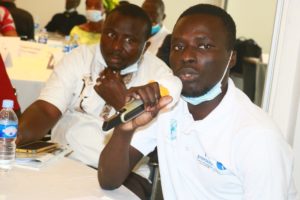

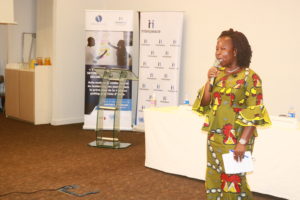
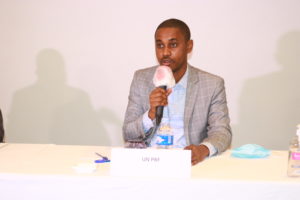
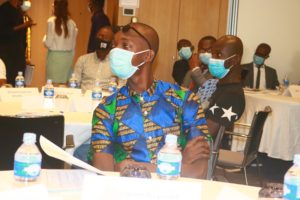
Dans le cadre du projet « YPS en pratique », une quarantaine de jeunes leaders œuvrant déjà pour la paix et la cohésion sociale dans leurs quartiers ont été sélectionnés. Après des séances de renforcement de capacités en analyse de conflit et gestion de projets, les jeunes hommes et femmes accompagnés par Indigo Côte d’Ivoire et Interpeace ont conçu et mis en œuvre leurs propres projets de consolidation de la paix et de prévention de la violence électorale à Abobo et Yopougon. Les résultats et bonnes pratiques à répliquer pour mettre les jeunes « au volant » des actions de paix et sécurité ont été rassemblés dans un Livre blanc. Celui-ci a été présenté le 7 septembre à Abidjan devant des représentants de ministères, municipalités, agences des Nations Unies, ambassades, ONG nationales et internationales et autres partenaires techniques et financiers.
En accompagnant ces jeunes, le projet a testé des moyens et outils pour améliorer leur esprit d’analyse, leur stratégie, leur impact et leur collaboration. Lors de l’événement, les participants ont partagé leurs impressions sur les résultats du projet.
"Avant l'arrivée d’Indigo, j’étais membre d'une ONG mais je ne me suis jamais dit que j’allais m’engager devant des gens ou être responsable d’un mouvement. Aujourd’hui, avec toutes les formations, je suis la coordonnatrice d’une plateforme de 40 initiatives au niveau de Yopougon", a dit Kiteni, de l’organisation de l’association des jeunes Tchêlê Woyê.
Ils ont également présenté le travail qu’ils menaient dans leurs communautés. Des jeunes femmes ont formé des ambassadeurs de paix, dont la mission était de sensibiliser leur entourage à la bonne entente entre communautés et d’alerter en cas d’incidents pour permettre la prévention des violences par le dialogue ou la mobilisation des autorités. Une autre initiative a formé des jeunes à la vérification des informations circulant sur les réseaux sociaux pour endiguer le phénomène des rumeurs et fausses nouvelles qui concourent à un climat de tensions et de violence. D’autres ont travaillé à rapprocher des personnes issues de secteurs, religions ou ethnies différents qui ne se fréquentaient pas ou étaient en conflit, à travers des dialogues et des activités d’intérêt général.
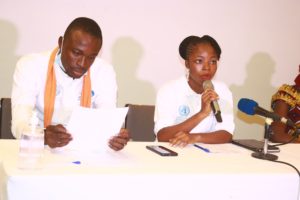
« Notre projet a associé toutes les parties prenantes [à un conflit opposant deux quartiers depuis la dernière crise socio-politique]. On a trouvé des solutions pour metre en place un climat paisible. Les populations ont donné elles-mêmes les solutions. Nous avons organsié un match de foot avec deux équipes mixtes des deux quartiers. Les équipes étaient mélangées et il n’y a pas eu de palabre [dispute] à la fin. » a dit Mariama, de l’initiative Jeunesse Unie pour le Développement.
Tous ont ouvert des espaces de discussion permettant aux personnes consultées de parler de leurs perceptions de la paix et de la sécurité dans le quartier, des traumatismes subis pendant les dernières crises, de l’état des relations avec les groupes opposés. Ces espaces de discussion ont souvent permis de réunir et créer un dialogue entre des groupes de personnes qui ne se parlaient jamais bien qu’habitant au même endroit. En adressant les divisions sociopolitiques, religieuses et ethniques dans leurs quartiers, les jeunes leaders ont également participé à la prévention des violence électorales qui pourraient survenir lors de prochaines échéances électorales.
"Lors du phénomènre de circulation des fausses nouvelles, au lieu de bruler les marchandises des Haoussas, [les participants de notre projet] les ont protégés des agressions dans le quartier. " raconte Kiteni, de l’organisation de l’association des jeunes Tchêlê Woyê, en référence à un épisode de violence intercommunautaire survenu le 5 mai à Abobo et Yopougon après la diffusion d’une fausse vidéo. Cette dernière prétendait montrer des Nigériens s’attaquant à leurs voisins Ivoiriens et incitait les habitants d’Abidjan à se venger.
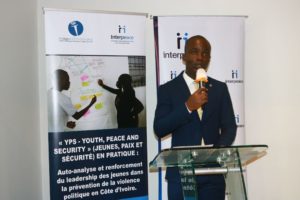
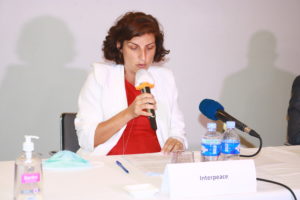
Grâce au projet YPS, les initiatives ont pu prendre conscience du rôle qu’elles avaient à jouer pour la paix, renforcer leurs capacités pour concevoir et mettre en œuvres des actions stratégiques et inclusives, et les communiquer à des décideurs locaux, nationaux et internationaux. A travers toutes ces actions, ces jeunes leaders ont montré que la jeunesse a la capacité d’agir pour la paix et la sécurité.
Citant l’ancien président américain John F. Kennedy, Jean-Luc, membre de l’association Young Ivoirian Promoters of English a ainsi conclu la présentation des résultats du projet en disant : « Ne vous demandez pas ce que votre pays peut faire pour vous, mais demandez-vous ce que vous pouvez faire pour votre pays ».
En Côte d’Ivoire comme ailleurs, les jeunes ont la volonté et le potentiel pour contribuer à la paix et stabilité dans leur pays. Il revient au grand public, aux acteurs nationaux et internationaux de reconnaître leur rôle important dans la construction de la paix durable et de leur donner des outils de participation dans la prise de décisions politiques et sécuritaires.