“We are in great pain, having lost our children and our property. We are living in shadows and going around in shadows. If you go to other places now, people are farming, have you seen any farm here? All of these are farms, but lack of peace has restricted us from doing any of that, we sit here staring at each other.” -Resident in Kapedo
Despite numerous mediation efforts, peace has remained elusive in the Kerio and Suguta valley of North Rift region, likely due to the noninvolvement of the communities in the identification of conflict sources, community resilience factors, as well as in the development and implementation of solutions.
It is against this background that Interpeace and the National Cohesion and Integration Commission (NCIC) began the implementation of the programme Strengthening Community Resilience for Sustainable Peace in Selected Fragile Counties in Devolved Kenya.
The programme adapted the participatory action research (PAR) methodology, and has since 2019 helped communities turn conflict-prone zones into epicentres of peace by engaging communities in formulating strategies on how they can be empowered in developing and implementing solutions on how to resolve conflict.
The valley of Suguta, known as the ‘valley of death’, had become synonymous with violence, grieving, and loss caused by cattle raids, pillage, or massacres. As violence spiralled between the Turkana and Pokot communities, local police recorded an average of six deaths and three livestock raids every month prior to 2021. Villages along the Chemolingot- Lokori corridor have become synonymous with bloody conflict, grieving, and loss. Escalatory cycles of violence have drawn extended ethic affinity networks into the fray, embedding animosities and fear, as the Pokot and Turkana clans have become locked in a battle for survival against each other.
In this area young pastoralists openly carried AK-47s as they herded flocks of camels, cows, and goats. These conditions rapidly created social and economic paralysis. Roads were closed, schools, businesses, and markets shuttered as a precaution and from panic.
Historically the communities in the Kapedo-Lomelo route along the Chemolingot- Lokori corridor have been strong enemies and even meeting each other was a tall order. Commerce was effectively disabled, and informal territorial no-go zones emerged.
Interpeace and its partner NCIC held multiple community dialogues to understand the challenges and grievances of both clans, as well as the exploring the benefits to erring on the side of peace. In the community dialogues, conflict parties arrived at a consensus not only in the urgent need to achieve peace, but also to agree on concrete solutions on how to sustain it.
In July 2021, Pokot and Turkana elders signed the Orwa Peace Accord, putting an end to decades of cyclical conflict and deadly violence. Before Orwa, many peace agreements signed in the North Rift had broken down, because they were not implemented or could not be transferred from the negotiating ‘table’ to the ‘town-square’. The accord put an end to decades of cyclical conflict and deadly violence, was possible due to the willingness and commitment of communities to share a new future together.
Most importantly, the 2021 Accord, designed by both clans, continues to affirm that sustainable peace is the responsibility – led and protected – by the communities.
The Tugen communities of Baringo east as well as the Ilchamus and Pokot communities in Mukutani have been tied in conflict for decades. The warring communities were not interacting with each other, creating a vacuum of fear and suspicion among them, which further exacerbated the tensions between the communities.
Since 2020, Interpeace and NCIC have been bringing the elders together to discuss on conflict as well as insecurity facing them. These engagements instilled reason in their minds thus accepting to meeting their counterparts for peaceful discussions. The partner organizations have also been engaging respective community elders on rigorous discsussions around having inter-community peace talks.
In March 2020 members of the Pokot, Tugen, Ilchamus, Turkana and Samburu communities participated in formation of community lead peace infrastructure- Ceasefire Monitoring Committees (CMCs) that spearheaded the ceasefire across the North Rift region.
CMCs create the conditions to transform conflict. They seek to identify and mitigate the key triggers of fear and mistrust that create inter-community hostility. In addition, members of the CMCs work with communities to ensure that local militias keep away guns, ensure that displaced persons return home, initiate and facilitate dialogue, and enhance social cohesion. The CMCs work to restore trust, nurture a culture of peace and reconciliation, and address structural issues that often trigger conflict in the communities.
When a conflict incident or crime occurs, members of the CMC from both clans show up on the spot, to interact with affected villagers, who can engage in their own language with an elder they trust. This inter-clan collaboration reduces fear, particularly when opposing clan members are involved in a skirmish or suspect one another of a crime. CMCs offer multi-dimensional roles and reach, like “a new sheriff in town”.
“For 85 years I have run across the Suguta Valley organising raids or recovering my raided livestock, but the last two years of my involvement in peace have shown me a life beyond this valley. I have travelled to Nakuru, Nairobi, and Mandera, learning how to live with other people. My two years of peace are worth much more than my 85 years of living in conflict,” said an member of the CMC.
Interpeace would like to thank the Government of Germany and the United Kingdom, the European Union in Kenya, and the Swiss Embassy in Kenya for their support in creating spaces for peace in the North Rift region in Kenya. Interpeace is also grateful to its local partners, NCIC, the North Rift Counties of Baringo, Elgeyo-Marakwet, West Pokot, Turkana and Samburu, as well as the Frontier Counties Development Council(FCDC) for their crucial contributions to these community-led peace efforts.
The people in the Mandera County in Kenya have experienced their fair share of conflict and violence in the past decade. Nestled in Kenya’s north-eastern corner, bordering Somalia and Ethiopia, the county has been plagued by killing, livestock raids, cross border attacks and retaliation, played out among large pastoralist clans.
In this region, villages are scattered across land divided by ethnic groupings and some designated colonial borders, seemingly arbitrary lines across which people and animals regularly roam in search of grazing pastures. Histories of violence blanket the region whose nomadic practice have always disregarded borders that obstruct their wandering way of life.
Exacerbated by the scarcity of resources and the neglect to improve public services and infrastructure, inter-clan violence plagued the county, further reinforcing the vicious cycle of suffering and instability. In particular, the conflict between the Garre and Degodia clans of 2010-2015 has since led to the displacement of more than 18,000 households and the deaths of more than 70 people. Pockets of internally displaced persons still live in the county awaiting resettlement.
However, in 2020, leaders from Garre and Degodia clans committed to end hostilities, enshrined in the signature of the Banissa peace declaration which led to the immediate cessation of hostilities and reduction in criminal activities such as raids and property damage, which led to much lower levels of internal displacement.
Facilitated by Interpeace and its local partner the National Cohesion and Integration Commission (NCIC), the declaration was the fruit of the dialogues of local leaders themselves which reflected a cross-clan desire for peace. Reinforced by the creation of the Ceasefire Monitoring Committees (CMCs), the declaration is still in effect and is being respected, but the efforts towards reconciliation and strengthening social cohesion continue to this day.
Creating lasting peace in the region does not end with the signature of one agreement. Interclan conflicts still plague the region, yet the work of Interpeace and its partners continue, building on what has been learned in the years of community engagement and consultations in the county.
Between 2010 and 2020, movement of people and livestock between the villages of Domal-Choroqo, Banisa-Guba , Malkamari-Eymole, Boqonsar-Handrak, Malkaruqa-Ardagarbicha was heavily restricted due to fear of attacks and theft. Inhabited by the opposing Garre and Degodia clans, members of these villages have for years battled over the scarce resources of the area – issues of land ownership as well as grazing rights were exacerbated by political conflict. These 5 villages are located in the buffer zones of the two clans and have suffered most from the effects of the vicious cycles of violence.
Interpeace and its partner NCIC mobilized community members to participate in dialogue meetings, acting as mediators among elders, local administrators, youth and women from the 5 villages. Interpeace and NCIC created inter-village dialogue spaces, where members from different sides of the conflict came together to develop solutions to preventing and mitigating inter-clan escalations. Taking up the role of mediators, Interpeace and NCIC held dialogues among the different constituencies, recognising that these villages, while at the buffer zone that delineates clan divides, are also the frontliners to ensure peace and dialogue between the clans.
In March 2020, 5 intervillage pacts were agreed by members of the Garre and Degodia clans, including the sharing of water and pasture between the towns. Since the signature of the pacts, the clans agreed to share their resources and resolve disputes peacefully.
The intervillage dialogues carried out in this conflict has been the model Interpeace and NCIC have been using to provide peaceful approaches to long-standing interclan conflicts in Mandera and the North Rift of Kenya. This dialogue model has also spread to Ethiopia, opening up relations across the Kenyan-Ethiopian border which has led to safe cross border movement of people, trade and livestock in search of water and pasture.
In addition to conflicts that arrive from resource disputes, Mandera also experiences conflicts that arise from border disputes among different clans and villages. One such case was seen between the Murulle and Garre clans, located close to Somalia, whose inter-clan border disputes continued to ensue despite accords that were not respected by both sides in the past decade. Ceasefire attempts have been made since 2000, but the conflict has continued to escalate which has led to death and destruction to both clans for the past two decades.
Interpeace,NCIC and the Mandera county government first examined the reasons behind the violence despite previous accords, and after consultations with members from both clans, it was clear that the deadlocks were caused by lack of representation and influence of both clans in the mediation process. Preceding peace processes provided very little roles for both clans in the judgement and creation of the accords, which has led to the communities to return to violent solutions to resource disputes.
On the request of the conflicting communities, Interpeace and NCIC brought an external arbiter whom the two clans trusted. other intergovernmental agencies – the Ministry of Interior, Ministry of Land, Survey of Kenya, National Land Commission (NLC), National Steering Committee on Peacebuilding (NSC) and the Independent Electoral and Boundary Commission were brought on board– to the negotiation table to arrive at a sustainable solution to this deadly stalemate. The process led to two clear verdicts, co-designed and agreed upon by the conflicting groups: (1) the immediate cessation of hostilities and directives for reparation to be led by the local peace infrastructure and (2) that the border dispute will fall under the government who will delineate the disputed territory.
On February 8 2021, the political class, elders, religious leaders, civil society members and members of security team witnessed the signing of the Sheikh Umal II peace accord between the Murulle and Garre clans at the County headquarters’ hall.
The accord led to compensation of destroyed and vandalized properties during the conflict. It was also during this accord that the government was tasked with delimitation of the contested boundary to bring permanent solution to the conflict, which has also opened opportunities for collaboration and restoring trust between the clans and the local government. The process of intergovernmental agencies to demarcate the border is ongoing.
Interpeace would like to thank the Government of Germany, the United Kingdom, the European Union in Kenya, and the Swiss Embassy in Kenya for their support in creating spaces for peace in Mandera County and other Interpeace programme areas in Kenya. Interpeace is also grateful to its local partners, NCIC, the Mandera County, as well as the Frontiers Counties Development Council ( FCDC) for their crucial contributions to these community-led peace efforts.
The ongoing incursion into Ukraine by Russian military forces is both shocking and heartbreaking. It constitutes an alarming violation of international law that needlessly places the lives of millions of civilians at risk.
Interpeace is all too aware of the devastating cost of conflict, and we join Ukrainians, and citizens the world over, in calling for an end to the violence. Dialogue and understanding are the only routes to resolving the fears, tensions and grievances that are fuelling this crisis.
Interpeace joins the international community in unequivocally condemning these attacks and in calling for the restoration and preservation of a rules-based international system. We urge all the parties to return to the dialogue table and pave the way towards an inclusive and lasting peace.
Almost 75% of the population of Côte d’Ivoire are under 35 years old. Despite being the majority of its population, the youth in Côte d’Ivoire are often associated with or are perceived as drivers of political violence.
To combat this misperception, Interpeace and its partner Indigo Côte d’Ivoire implemented the project “YPS in Practice,” which aimed to foster the participation of the country’s youth as actors and leaders in peacebuilding activities.
Funded by the United Nations Peacebuilding Fund (UN PBF), the project identified 40 young leaders from 7 community initiatives already active in their neighborhoods in Yopougon and Abobo, trained and accompanied them in the strategic design and inclusive implementation of peacebuilding and political violence prevention projects.
“In this project, the youth were not viewed as beneficiaries, nor as implementing partners at best; rather, the young Ivoirians themselves took the helm and were at the heart of all the peacebuilding activities carried out, from planning to implementation,” said Margaux Pimond, Interpeace’s Côte d’Ivoire Programme Manager.
[xyz-ips snippet="YPS-COTE-DIVOIRE-POST"]
At the end of the project, Interpeace, Indigo CI and the young leaders identified the lessons learned and good practices and compiled them in a White Paper. This paper provides practical guidance to governments, donors, NGOs, international organizations and private sector actors who wish to encourage the participation and contribution of youth to peace and security efforts, in Côte d'Ivoire and elsewhere.
Awa Diabate, Research assistant at Indigo Côte d’Ivoire recalls that “one needs to adopt a flexible approach and adapt to capacities and priorities of young leaders, in order to successfully apply the YPS agenda into practice”.
In the publication, some good practices highlight the importance of reaching young people from diverse backgrounds, the advantage of involving social elders as mentors to bridge the intergenerational gap, the interest of training young people in the analysis of context to guide their actions, as well as the importance of supporting them in the design and implementation of their own projects.
[xyz-ips snippet="YPS-COTE-DIVOIRE-PDF-POST"]
To know more about the project, please contact samain@interpeace.org
The International Labour Organization has signed a Memorandum of Understanding (MoU) with Interpeace aimed at “operationalizing the ILO’s conflict-sensitive and peace-responsive programming”.
The MoU also aims at encouraging closer collaboration between the two organizations around the Humanitarian-Development-Peace Nexus. The Nexus recognizes that policy and programmatic approaches to employment, decent work, and other interventions in conflict-affected settings do no harm and strengthen prospects for peace.
The MoU is in line with the UN Sustaining Peace agenda that recognizes that achieving development outcomes, and reducing humanitarian need, is dependent upon preventing and transforming violent conflict.
The UN Secretary-General has called on all UN entities to integrate the approach to sustaining peace in their strategic planning.
“We know that there won't be any sustainable development without peace, and there's no peace without development. However, nobody can do it alone and so we need to join forces because peace is everybody's business,” said the ILO Deputy Director-General for Policy Martha E. Newton. “I take this opportunity to thank Interpeace President Scott M. Weber and his staff for our excellent cooperation to date and look forward to continued strong ties between our two institutions.”
“Fair access to decent work and sustainable livelihoods for all groups in society is key to addressing underlying grievances and building trust,” said Scott Weber, President Interpeace. “This MoU signals our joint effort to shift the Nexus from mere policy to practice and our shared interest in building on the resilience of communities with whom the ILO works. It is only when various actors within the system come together, such as Interpeace and the ILO, that we can change how needs are met and peace is sustained.”
Interpeace is an international organization that prevents violence and builds lasting peace through in-country programmes, collaborative partnerships and high-level policy influencing. Interpeace has a strategic mandate to build the peace responsive capacity of development and humanitarian organizations, in particular the United Nations. Interpeace’s work on peace responsiveness, and more specifically the collaboration with ILO, is made possible through the support of Global Affairs Canada.
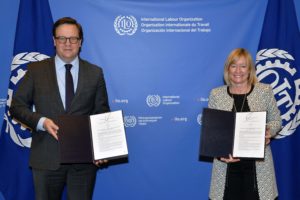
Last year, Interpeace helped the ILO develop organizational guidance to conducting peace and conflict analysis as part of its strategy and project design process. Currently, the ILO is partnering with Interpeace to undertake peace and conflict analyses at the country level in Libya, Cameroon and Sudan. This is aimed at ensuring that ILO programmes explicitly address conflict drivers such as perception of injustice between host communities and forcibly displaced populations, lack of social justice, decent work deficits and unemployment. At the same time, this will reinforce the contribution of the constituents – representatives of governments, employers’ and workers’ organizations – to sustain peace.
It also reflects a historic commitment, as the ILO was founded after the First World War to promote stability and social justice through decent work. This was reaffirmed in the ILO’s Recommendation on Employment and Decent Work for Peace and Resilience (No. 205), adopted by the International Labour Conference in 2017, which provides the key international normative framework and underscores the central role of employment and decent work in crisis situations arising from conflicts and disasters. The ILO has proactively contributed to building and sustaining peace by launching the Jobs for Peace and Resilience flagship programme, and establishing the Coordination and Support Unit for Peace and Resilience (CSPR). Furthermore, with the support of the Swiss Confederation, in 2018 the ILO reinforced its partnership with the UN Peacebuilding Support Office (PBSO) to promote the key role of the Decent Work agenda in sustaining peace.
The MoU reflects a mutual commitment to build on and complement efforts in the areas of awareness-raising and strategy development; knowledge generation, external advocacy and policy engagement; capacity-strengthening and support to programming; collaborative programming; and enhancing the enabling environment for peace responsiveness.
For the first time in more than half a century, three districts in the Puntland state of Somalia held “one person, one vote” elections last 25 October 2021.
The recently held elections in Puntland sets a historic precedent towards a more democratic process, where citizens themselves can elect their government leaders. Currently, Somalia’s government leaders are voted through indirect elections, with clan representatives electing parliamentarians who then vote for the country’s top representatives.
“The participation and jubilation from the population was truly profound,” said Ahmed Abdullahi, Interpeace’s Somalia Country Representative. “You could sense that there was a strong recognition of the significance of the historic process, a recognition that this will pave the way for Somalia’s democratization.”
One person, one vote election
The efforts of the past two decades as well as the increased awareness and engagement of civil society have created the conditions and demand for the successful early elections. There was also strong political will from the Puntland leadership, especially from the office of President Said Abdullahi Deni, demonstrating the support from the political elite and the recognition of the demand from their people.
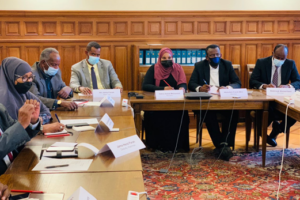
Commissioner Guled Salah, Chairman of the Transitional Puntland Electoral Commission (TPEC), underlined how these elections is the product of many years of working towards democratization in Puntland.
“The first and the second TPEC rooted Puntland’s democratization process, drafting necessary electoral laws and guidelines. However, the commissions faced enormous challenges and ‘one person, one vote’ elections did not materialize,” said the Chair of TPEC, responsible for the management and rollout of Puntland’s local government elections. “Now a decade later, the vision of universal suffrage was achieved in three districts and we intend to finalize the remaining 47 districts by mid-2022.“
Beyond its historical significance, the municipal elections aim to inform how parliamentary and presidential elections at the state levels will be carried out, as well as lay the foundations for federal universal suffrage in 2025. The continued success of subsequent Puntland district elections is critical in paving the way for a bottom-up approach to electoral processes.
Inclusion and social cohesion towards electoral legitimacy
The recent elections garnered significant support from the population, including from the youth and women. More than 28,000 people cast their votes in Eyl, Ufeyn and Qardo democratically electing 87 council members, of whom 23 are women. More than 51% of the registered voters were women, and the youth accounted for more than half of the votes in all the three municipalities as well.
The universal suffrage system also allowed for internally displaced communities (IDPs) from other regions in the country to exercise their rights to vote and run for public offices as prescribed in the constitution. Muhsin Abdullahi, an IDP candidate, was among the councilors elected in Qardo.
Interpeace and its long-time partner, the Puntland Development and Research Center (PDRC), continued the effort of laying the foundations for local government elections by strengthening the social cohesion and increasing trust between the state and society.
These efforts were critical in creating the right conditions and conducive environment for public participation in the governance process and supporting peace infrastructures that allowed for credible and legitimate elections to take place.
“Interpeace is the oldest partner of TPEC and were the pioneers in supporting grassroot democratic processes in Puntland and supported the early electoral commissioners from 2012,” said Chairman Salah. “Interpeace’s role was instrumental in laying the foundations of this democratic journey.”
Building momentum towards 2025
Interpeace and its partners will continue to work with TPEC to ensure transparent and inclusive elections take place in the next phase of the elections. As part of its support, Interpeace has hosted TPEC in Geneva from 30 November to 4 December 2021 for a study tour, to learn and exchange experiences with number of stakeholders and experts on democratization and electoral processes.
This included exchanges with the Kofi Annan Foundation’s Electoral Integrity Initiative, the Geneva Cantonal Electoral authorities and the Institute of Federalism. The commission also met with the Somali Community in Geneva to solicit their support as part of their ongoing efforts to get the diaspora community to financially contribute to the electoral process.
“The main challenge now is maintaining and building on the political will from various stakeholders, including the public” said Abdullahi. “There are 47 other districts in Puntland preparing for elections, and this poses great logistical and resource challenges. For this to happen, significant collaboration and coordination among all partners is paramount.”