The Counterstrike Generation
Instead of investing in young peacebuilders, counter-terrorism made them a suspect community — endangered by extremist groups and by their own governments.
This policy brief presents an analysis of the dangers and challenges posed by the “securitization” of the YPS agenda, addressing both hard counter-terrorism approaches that target youth in the name of countering violent extremism (CVE), and the increasingly pervasive influence of ‘softer’ securitization through the guise of preventing violent extremism (PVE). It draws attention to the fact that instead of cultivating and investing in the role of young peacebuilders, young women and men are still subject to forms of ‘policy panic’ which result in them being endangered not only by terrorist organizations, but also by the counter-terrorist strategies of their own governments. This brief concludes with recommendations for how stakeholders supportive of the YPS agenda can confront the securitization of young people, and strategize to protect the rights of young men and women at both the drafting and implementation stages of counterterrorism policies and programs.
Click the cover to read it here
Key recommendations
- Document and expose counter-terrorism measures that harm young people, and take the violations to human rights mechanisms — among them the Special Rapporteur on human rights while countering terrorism.
- Evaluate the C/PVE programmes that claim to empower youth, through youth-led participatory assessment that includes marginalised and stereotyped young people, not only youth elites.
- Strip counter-terrorist language and thinking out of YPS resolutions and practice, and make explicit how YPS work differs from youth-focused C/PVE.
Author

Ali Altiok is a doctoral student in Peace Studies and Political Science at the University of Notre Dame. His research examines political inclusion and securitization of young people in the context of peacebuilding processes. Ali previously worked as a researcher, policy officer, and coordinator for several international peacebuilding organizations in New York. As an in-house research consultant at the United Nations Peacebuilding Support Office, he supported data analysis and narrative development of The Missing Peace: Independent Progress Study on Youth, Peace and Security, mandated by the United Nations Security Council Resolution 2250. He is co-author of the policy paper, We Are Here: An Integrated Approach to Youth Inclusive Peace Processes for the UN Secretary General’s Envoy on Youth. Ali is a former member of the United Networks of Young Peacebuilders and the founder of the Youth, Peace, and Security Research Network.
All briefs in this series
 A Youth-Centric Vision for Sudan: Transformative Change, Power, Peace and Transitional Justice
 Not Thirty Pesos, but Thirty Years: Youth and the Quest for Constitutional Change in Chile
 Evaluating Youth Representation to the United Nations - Reflections and Recommendations on the United Nations Youth Delegate Programme
 Assessing Youth Participation in Implementation of the YPS Agenda
 The Counterstrike Generation
 Voices From the Margins: Young Men and Post-Conflict Masculinities in Northern Ireland
 Psychosocial Support and Societal Transformation
 Beneath the Wakashio Oil Spill: Exploring the Linkages Between Youth Marginalization, Environmental Disaster, and Resilience for Peace in a Small Island State
 Youth as Guardians of the Future – Sustaining Climate, Peace and Security in an Urbanizing World
 Resilience in the Face of Exclusion: Stories From Kenyan and Swedish Youth
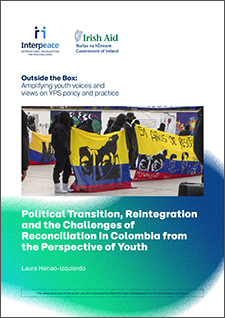 Political Transition, Reintegration, and the Challenges of Reconciliation in Colombia From the Perspective of Youth
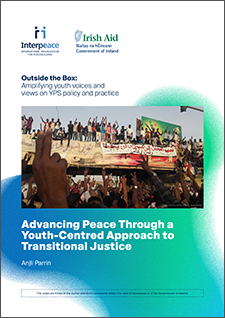 Advancing Peace Through a Youth-Centered Approach to Transitional Justice
