Most severe hunger crises around the world occur in situations affected by violent conflict. Finding better ways to address and prevent violent conflict is therefore necessary to eradicate hunger. In this regard, the Organisation des Nations Unies pour l'alimentation et l'agriculture - FAO developed a corporate framework in 2018 that outlines how the organization contributes to sustaining peace through its interventions. Moving forward, FAO intends to understand better the conflict dynamics in which its programmes take place, in order to ensure it does no harm, but also identifies where it can help strengthen and consolidate local peace.
In 2017, FAO sought the expertise of Interpeace, made available through Interpeace’s Advisory Team (IPAT), to operationalise this corporate framework. Over the course of 2018, Interpeace and FAO developed and tested tools that will enable more systematic and robust conflict-sensitive programming. One of the most important products from this partnership was the The Programme Clinic Facilitation Guide. Following a year of testing in FAO field offices, this publication is a self-explanatory guide that helps users make their project or programme conflict-sensitive. The guide provides a multi-step process that empowers staff to effectively apply conflict-sensitive programme design in fragile and conflict-affected contexts; twelve FAO country offices have used this Programme Clinic approach to date, which is supported by a Guide to Context Analysis to inform FAO decision-making. The Programme Clinic Facilitation Guide is the first step in an ongoing process that will help further strengthen the contributions to local peace through FAO programmes aimed at strengthening resilience and achieving socio-economic development outcomes.
Interpeace and FAO are now embarking on a second phase of this joint work. IPAT will accompany FAO in further strengthening its internal capacities and processes for conflict-sensitive programming, as well as distilling typical pathways through which FAO programmes contribute to local peace impacts, within the scope of its mandate.
With this partnership, IPAT pursues the second part of Interpeace’s mandate, assisting the international community in playing a more effective role in supporting peacebuilding efforts around the world.
It is also part of IPAT’s wider efforts to accompany humanitarian and development actors in becoming more “peace responsive” so that international efforts collectively aggregate to greater peace impacts. This is based on the premise that peacebuilding is not only a set of dedicated activities undertaken by specialized organisations like Interpeace, but also a way of engaging in conflict-affected societies that, if adopted and applied by a larger set of actors, has the potential to really ‘up the game’ for peace and SDG 16.
For more background information about our partnership, read:
ABIDJAN, 01 octobre 2019 – Les jeunes Ivoiriens sont souvent stigmatisés et qualifiés de responsables de violences et d’obstacles à la paix. Or, beaucoup d’entre eux œuvrent activement en faveur de la paix et de la sécurité dans leur pays. Un événement les met à l’honneur pendant trois jours à Abidjan lors desquels certains partageront leurs expériences.
Du 10 au 12 octobre 2019, le « Youth for Peace Côte d’Ivoire » aura lieu à l’Institut Goethe - Côte d’Ivoire, à l’Institut français de Côte d’Ivoire et à Attécoubé (une commune d’Abidjan) à partir de 8 h 30 chaque jour, sur le thème « La contribution des jeunes pour la consolidation de la paix en Côte d’Ivoire ». Des jeunes de tous les horizons du pays échangeront et partageront des récits inspirants et importants de leurs expériences de consolidation de la paix, de renoncement à la violence, à la haine et à l'extrémisme dans les communautés du pays.
Ce forum de trois jours est organisé par l'ONG N’zarama Center for Peacebuilding, Indigo-Côte d’Ivoire et l’organisation internationale pour la consolidation de paix, Interpeace, et soutenu par la Communauté économique des Etats de l’Afrique de l’Ouest (CEDEAO), l’Agence allemande de coopération internationale (GIZ), l’Ambassade de Suisse, l’Ambassade de France, l'Institut français d'Abidjan, l’Union européenne (UE) et le Programme des Nations Unies pour le Développement (PNUD).
Le « Youth for Peace Côte d’Ivoire » vise à faciliter un processus qui renforce la participation effective des jeunes à la planification et à la construction d’une paix durable en Côte d’Ivoire. L’événement créera une plate-forme inclusive pour les jeunes qui leur permettra de partager des idées, des expériences et des approches innovatrices.
« Plus qu’un événement, le « Youth for Peace Côte d’Ivoire » est le symbole de la jeunesse engagée pour la paix en Côte d’Ivoire. On ne parle pas assez de ces jeunes ; or leurs histoires nous inspirent, et vont vous inspirer à votre tour. », a dit Mathilde Boddaert, Chargée de programme, Côte d’Ivoire chez Interpeace.
Le 10 octobre, un espace de dialogue national sera ouvert entre des jeunes bâtisseurs de la paix et des décideurs politiques en Côte d’Ivoire sur la participation significative des jeunes à la paix et à la sécurité en Côte d’Ivoire.
« Les jeunes apporteront une valeur ajoutée. Les jeunes sont les leaders du ‘maintenant’ et non de demain et devraient avoir une chance de diriger », a déclaré Tony Karbo, directeur exécutif de N’Zarama Center for Peacebuilding.
Les Abidjan Peace Talks le 11 octobre constituent un fait marquant du forum « Youth for Peace Côte d’Ivoire ». C’est la première fois que les Peace Talks, une initiative mondiale qui s’appuie sur l’idée que tout le monde peut jouer un rôle dans la construction de la paix, se rendent en Côte d'Ivoire et la seconde fois en Afrique après Nairobi au Kenya en 2015. Les Peace Talks, une initiative mondiale établis en partenariat entre l’Office des Nations Unies à Genève, Interpeace et la Geneva Peacebuilding Platform se concentrent sur des histoires personnelles en tant que moyen de partager des idées et des solutions pratiques.
« Abidjan Peace Talks célèbre les histoires personnelles de jeunes Ivoiriens à la fois exceptionnels et ordinaires, qui montrent que la paix est l’affaire de tous ; que chacun peut y contribuer à son niveau », a ajouté madame Boddaert.
Au cours d’interventions de huit minutes, Charles Davy Aka, un jeune Ivoirien qui s’emploie depuis quelques années à motiver la jeunesse à discuter pacifiquement des problèmes qu’elle rencontre, se joindra à Marie-Claude Akpetou, une fille de 19 ans qui bâtit la paix à travers la littérature et les blogs.
Parmi les autres intervenants figurent le jeune bâtisseur de paix primé Gnamien Joachim Attoubré, co-fondateur et directeur d’un mouvement citoyen ivoirien nommé LIPEC qui fait la promotion de la paix et de la cohésion sociale; la jeune Bamba Madia, ambassadrice de JCI-Ivoire pour la transformation positive des communautés et fondatrice de « Bridge » et « Encore-Elles », des espaces de discussion physique pour les jeunes et jeunes femmes respectivement ; Michele Gnokile, l’initiatrice de “concept de paix” qui vise à sensibiliser spécialement les enfants sur le bien-fondé de la paix et de la cohésion sociale ; Boris Kone, secrétaire général de l’ONG Rêve d’enfant qui milite en faveur des enfants vivants avec des handicaps et cherche surtout à changer les paradigmes des enfants très influencés par les crises successives que la Côte d’Ivoire a traversées ; Kouassi Ange Aristide, président et fondateur de l’ONG EDUCAMENT, spécialisée dans la promotion de l’éducation sociale en Afrique ; et Honoré Zamblé, fondateur du Comité de Veille (CDV), une entité qui vise à sensibiliser les élevés à la non-violence et contre l’abus de l’alcool et les substances psychotropes afin de promouvoir la paix et la cohésion en milieu scolaire ; Béatrice Aya Koffi, une jeune ivoirienne victime de violence qui est devenu bâtisseur de paix en Cote d’Ivoire et Issouf Ouattara, président fondateur de An-Nour sport academy football club, qui s’occupe des enfants non scolarisés.
Le 12 octobre, Abidjan Peace Projections portera les voix des jeunes orateurs à une audience plus large. Leurs expériences stimulantes seront diffusées par vidéo, suivies par des échanges en public dans quatre quartiers populaires d’Abidjan : Attécoubé, Youpougon, Abobo et Koumassi.
Pour participer à ce forum Youth for Peace Côte d’Ivoire, inscrivez-vous sur ce lien : https://y4p.eventbrite.com
Contacts médias:
N’zarama Center for Peacebuilding, Stephanie Minou, chargée de programme, e-mail: stephanieminou@nzarama.org, tel: +225 84 88 61 63
Indigo Côte d’Ivoire, Arsène Konan, coordonnateur de programme, email: arsene.konan@indigo-ci.org, tel: +225 56 97 88 83
Interpeace, Jude Fuhnwi, chargée de communication globale, e-mail: fuhnwi@interpeace.org, tel: +233 544 506 505
Seven years ago, Mali came into the spotlight as violence broke out following an attempt by armed groups to seize control of the North of the country and a military coup. While democracy was returned one year later, instability remains. Since then, Mali has consistently commanded international attention. The United Nations has over 13,000 peacekeepers stationed there and spends over $1 billion dollars a year on what’s officially its deadliest peacekeeping mission. And yet, despite the UN’s efforts, despite those of the Malian government and the rest of the international community, levels of violence continue to rise, as insecurity spreads from the North to include large sections of the center of the country.
Interpeace had been working with the Institut Malien de Recherche-Action pour la Paix (IMRAP) since 2014 and had discovered along the processes carried out at a national level that one of the critical missing pieces was the failure to meaningfully include local communities. The pioneering work of Interpeace and IMRAP—a self-portrait of Mali—had deliberately taken the national conversation on peace and security to Malian communities to help ensure their perspective was adequately taken into account. The work of IMRAP and Interpeace is an ongoing process that aims to sustain and deepen their engagement at country level. Doing so, we will continuously bring our support to the communities not just to talk, but to take action; to launch a national conversation to make sure peacebuilding was no longer an elite business, but an imperative for all.
Today we’re excited to announce the launch of “Vestibule de la Paix” a long-term, multi-partner initiative with the goal of supporting a community based and led approach to peacebuilding in Mali. Led by IMRAP, Interpeacela rejoint l’Institut des études du développement et un Humanity United (with the acronym H3I), we will be working with communities in the North, Center and South of Mali to supporting them in managing the conflicts without violence and help them build social cohesion. We will also be channeling that experience into conversations with the Malian government and key international players to see how they could shift their practices to harness the power and agency of local actors and build lasting peace.
As part of the partners’ commitment to supporting locally led peacebuilding, we’re proud to be part of this multi-stakeholder initiative that will enhance not only a four-way partnership collaboration but also will engage local, national and international actors at a same stage to propose sustainable solutions for lasting peace. We believe these efforts can be transformative for Malian communities and they can help fundamentally change approaches to peacebuilding in Mali and beyond.
For more information read -
Involving local communities in peacebuilding in Mali
Vestibule of Peace: New peacebuilding initiative in Mali launched
GENEVA, 17 September 2019 – Mistrust and suspicion are at the origin of the all too familiar violent conflicts around the world today. Violent conflicts tear apart society and destroy the trust that binds relationships. Trust is the foundation for lasting peace in society.
On Thursday, 19 September 2019, ahead of the International Day of Peace on 21 September, peacebuilders from around the world will share their personal stories and experiences at the 2019 Geneva Peace Talks, to highlight their efforts in promoting trust in conflict-affected regions of the world.
The event will take place at the United Nations Office at Geneva (UNOG), Building E, Room XVIII from 4:00pm to 6:00pm, Geneva time.
The Geneva Peace Talks are a public event co-organized by the l'Office des Nations Unies à Genève, Interpeace et Plateforme de consolidation de la paix de Genève to celebrate the International Day of Peace.
The 2019 Geneva Peace Talks is organized under the theme: Trust Matters!
The meaning of trust in today’s globalized world may vary across sectors, however, the essence of trust as a pillar for peace remains. Trust is the cornerstone for peace. It is the glue that holds relationships, societies and economies together.
The 2019 Geneva Peace Talks will bring together speakers from across different professional and personal backgrounds to share their personal stories and experiences in promoting trust as the foundation for society, through a series of 8-minute talks.
African entrepreneur and founder of Mo Ibrahim Foundation supporting good governance and great leadership in Africa, Mo Ibrahim, will join award winning filmmaker and winner of the 2019 Cannes Camera d’Or to share his personal story and experiences at this high-profile annual event for peace.
Other speakers include leading peace mediator, Antje Herrberg, Guatemalan global peacebuilder, Bernardo Arévalo de León and Colombian policewoman, Coronel Lurangeli Franco. Two young women, Zainab Nankya and Salama Ibrahim, involved in building bridges between religious communities in Nigeria and Uganda will also be sharing their stories and personal experiences alongside Dina Alami, a young person working to build bridges between youth and politicians in Sweden.
This diversity of speakers emphasizes that each and every one of us, regardless of our age and background, can contribute to promoting trust and peace in our communities and beyond.
The event will also feature live painting by Abbes Boukhobza and musical performance by Pososhok.
This year, Interpeace turns 25, marking a quarter century of experience building peace in over 20 countries in Africa, the Middle East, Latin America and Europe. Over this period, Interpeace has learned and applied several fundamental lessons about the nature of peace and conflict.
Evidence has demonstrated that the breakdown of trust—whether it be between governments and citizens; security forces and local communities; or between communities themselves—is consistently one of the most persistent drivers of conflict. Given the close link between mistrust and exclusion, Interpeace places particular emphasis on inclusion and dialogue as the primary tools for building sustainable, locally driven peace, anchored on trust.
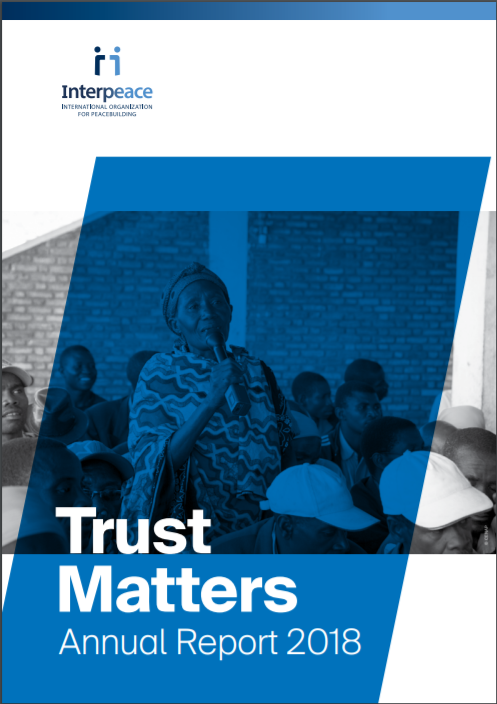
Our 2018 Annual Report, “Trust Matters” illustrates how we are working to foster and promote trust in conflict-affected regions of the world. From supporting statebuilding processes for over two decades in the Somali Region, to fostering trust and collaboration between the security sector and the population in Mali; and from strengthening the participation of women in decision-making processes in Guinea-Bissau, to collaborating with the World Health Organization (WHO) in the Democratic Republic of the Congo to build trust between members of communities affected by the Ebola outbreak and the health response teams. As evidenced by these examples, ever-changing circumstances and challenges around the world, have encouraged Interpeace to adapt and constantly develop innovative solutions, as well as build new partnerships to better prevent violence and transform conflict.
We all play a role in building peace. In our latest annual report, we hope to inspire people to better contribute to peace by focusing on building or re-building trust.
Kasaï was a relatively stable region in the Democratic Republic of Congo - a country struggling with multiple conflicts – until 2016 when violence erupted out of a locally rooted conflict. A violent dispute tore apart communities in the Kasaï region, turning the area into the epicenter of an intercommunal conflict that has engulfed the entire region and spread to neighboring Lomami and Sankuru provinces.
Kasaï is one of the poorest regions in the Democratic Republic of Congo (DRC) and is usually far off the radar of politicians and decision makers in the distant capital Kinshasa. This disconnection has failed to nurture the tradition of social integration and made it difficult for the local populations to see what connects them to each other. As a result, violence broke out in August 2016, pitting local militants against national government forces. Some 5,000 people were killed by the brutal war that raged for more than two years and 1.4 million others were displaced, according to United Nations figures.
Since then, people have struggled to recover from the two years of intense violent conflict as ethnic tensions simmer. The recent influx of over 300,000 people into Kasaï, mainly migrant workers and refugees forced to return home from Angola, is posing a threat of resurgence of violence as the region is still extremely fragile following previous conflicts. This large influx of returnees in Kasaï has stretched the already inadequate resources and generated tensions between returnees and host communities, leading to skirmishes in some villages over limited food resources.
There is a danger that inter-communal tensions may resurface. In the heat of these rising conflicts, Interpeace has partnered with the Norwegian Refugee Council (NRC) and Fondation Hirondelle to restore trust among the Kasaï communities and reconcile them with DRC authorities.
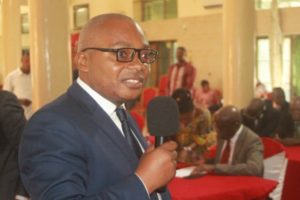
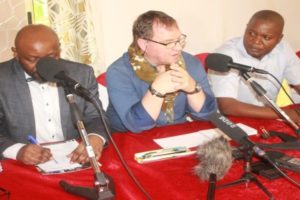
On 4 July 2019, our peacebuilding programme for Kasaï was launched in DRC at an event that brought together local and national representatives to present the programme and identify their common strengths for lasting peace in Kasaï and Central Kasaï . In total, 48 participants including women, local chiefs, community members, senior state officials at all levels, members of parliament and international development partners from the European Union, Interpeace, NRC and Fondation Hirondelle attended the launching ceremony.
“This peacebuilding project is relevant in the Kasai area after the conflict of 2016 to 2018 that led to loss of lives, breach of trust and serious human rights violations. I look forward to a fruitful cooperation with the provincial government through this programme to strengthen the interventions on the ground,” said the deputy Governor of Central Kasaï, Prof. Ambroise Kamukunyi.
Our programme, funded by the European Union, will develop and facilitate dialogue and mediation initiatives for reconciliation to support sustainable peace and stability. The goal is to enhance trust and social cohesion among local communities, authorities and security forces in the region of Kasaï and Central Kasaï, by helping them to overcome deep divisions and address their conflicts in a concerted, more inclusive and non-violent ways.
Interpeace’s action will be coordinated and implemented locally in partnership with three Congolese organizations: Action pour la Paix et la Concorde (APC), Travail et Droits de l’Homme (TDH) and the Commission Diocésiaine Justice et Paix Kananga (CDJPK).