Building family resilience is essential for a more resilient and cohesive Rwandan society
Resilience-oriented therapy, a promising approach to addressing mental health
Joining COP29: Weaving Peace in Climate Action to Strengthen Resilience in Fragile and Conflict-Affected Settings
Interpeace will participate at COP29 in Baku, Azerbaijan to spark innovative thinking around peace-positive climate adaptation and mitigation approaches to unlock greater climate action and finance in conflict-affected and fragile contexts.
Developing countries and conflict-affected areas bear the brunt of climate risks. Yet, only 20 to 25% of the $1.5 trillion in climate investments needed are funded, and development finance is providing less than 6% of the rate required.
The Peace, Relief, and Recovery Day on 15 November is a key opportunity to ignite policy and advocacy around the climate-peace nexus, including initiatives such as the Call on Climate Action for Peace, Relief and Recovery endorsed by Interpeace, and the Baku Climate and Peace Action Hub announced by the COP29 Presidency.
Highlights of the delegation’s activities in Baku include a panel organised jointly with the IOM on November 13, focusing on the need to strengthen partnerships between development finance institutions, the UN, and peacebuilding actors, to extend the reach of climate finance in countries most impacted by climate shocks and conflict. With the ISO, we will also advocate for the importance of positioning international standards as essential tools to ensure policy alignment, facilitate global cooperation, and enable collective action on critical issues.
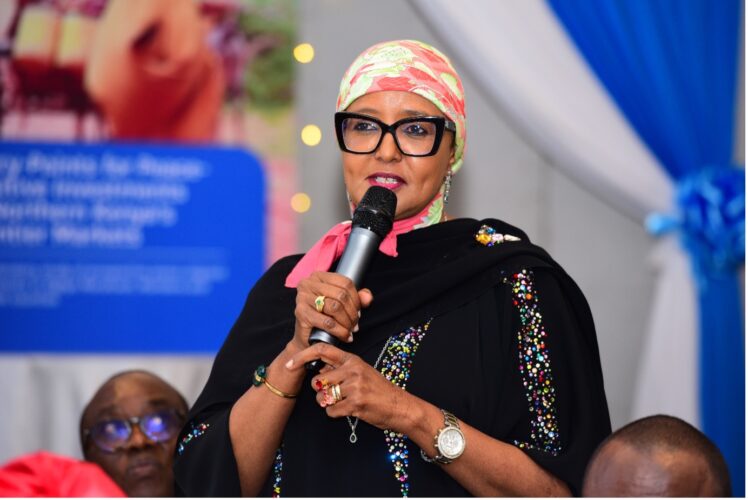
Member of Interpeace’s Governing Board Ambassador Amina Mohamed said: “Today marks a pivotal moment in our shared journey towards fostering stability and sustainable development in Northern Kenya. Through collective efforts we can unlock transformative change.”
Ambassador Mohammed outlined the importance of initiatives such as Finance for Peace by Interpeace, as the organisation has played a pivotal role in strengthening the capacity of local communities to manage conflicts and promote social cohesion. “These efforts”, she said, “have reshaped community relationships, reduced violence and nurtured trust among diverse stakeholders.
“As we navigate towards inclusive investment strategies, the concept of Peace Finance becomes paramount. By integrating peace efforts into our investment frameworks we can mitigate risks, enhance returns and contribute significantly to a peaceful and prosperous Northern Kenya”, Ambassador Mohammed said.
Principal Secretary of the State Department for Devolution Ms Terry Mbaika affirmed the Kenyan Government’s commitment to promote peace-positive investments in the country. She said: “It is clear that peacebuilding considerations need to be better integrated into development finance and mainstreamed into investment approaches.
“The Government is committed to integrating peace initiatives into its development agenda. We do this by ensuring that every step towards economic growth is accompanied by conscious efforts to maintain and enhance stability.” Ms Mbaika called for the alignment of investment opportunities with peacebuilding efforts to create mutual benefits for both investors and local communities.
Michael Pietsch of the German Embassy in Kenya said: "Germany is spearheading financing for peace. We need to ensure investments positively impact peace. We need Finance for Peace. Germany is partnering with Interpeace to develop a Peace Finance Impact Framework and Peace Finance Standard.
“Protracted conflicts across the globe have impeded development efforts and have led the UN Secretary-General to call upon the international community to intensify efforts for peace and identify new sources for financing for peace. Recently, UN Member States reiterated their commitment to building and sustaining peace when endorsing the Pact for the Future. However, public resources are scarce and we need more sustainable financing for peace.”
New challenges require new types of partnerships – Peacebuilding is meeting finance
Peacebuilding is facing greater challenges today than ever before. The number of conflicts worldwide is rising and the causes are well known, from a changing geopolitical landscape to the devastating impact of global warming and climate change, to continuing insufficient attention to economic and social inequalities, amongst other underlying shifts affecting security and peace. At almost the half-way point towards the UN’s Sustainable Development Goals (SDGs), only 12% are on track, and none of the targets for SDG 16 on ‘Peaceful, just and inclusive societies’ are close to being achieved in countries affected by conflict and fragility.[1]
It is also well known that successful peacebuilding does not necessarily require large-scale funding. But it does require predictable and long-term funding – peace cannot be built overnight. Yet, Official Development Assistance (ODA) earmarked for peacebuilding and conflict prevention is at a record low4. And most financial support for peacebuilding is in the form of short-term government grants that presuppose that peace can be designed, achieved and consolidated within short timeframes.
Nor is there sufficient action to follow the fact that peacebuilding makes economic sense: every US dollar invested in peacebuilding carries a potential USD 16 reduction in the cost of armed conflict.[2]
The model for financing of peacebuilding requires new actors and new solutions to meet the fundamental needs of predictability, long-term investment, and diversification beyond dependence on a limited number of government donors. Done thoughtfully, a new model can be a ‘win-win’ for both the peacebuilding sector and the finance sector.
Capital is available, including for fragile and conflict-affected settings (FCS), but it usually cannot find its way to the so- called “frontier markets” because of real or perceived risks, including financial, political and reputational concerns. Most investment products currently available on the market are focused on green or development outcomes, with little, if any, consideration of conflict-sensitivity as a precondition for their success. And beyond the relative passivity of applying a conflict-sensitive lens – ensuring that an investment at least does not make matters worse – even less attention is given to more forward-leaning approaches. Well-designed investment can make a deliberate positive difference, offering the prospect of less risk and greater financial returns as well as more enduringly peaceful societies where those investments occur.
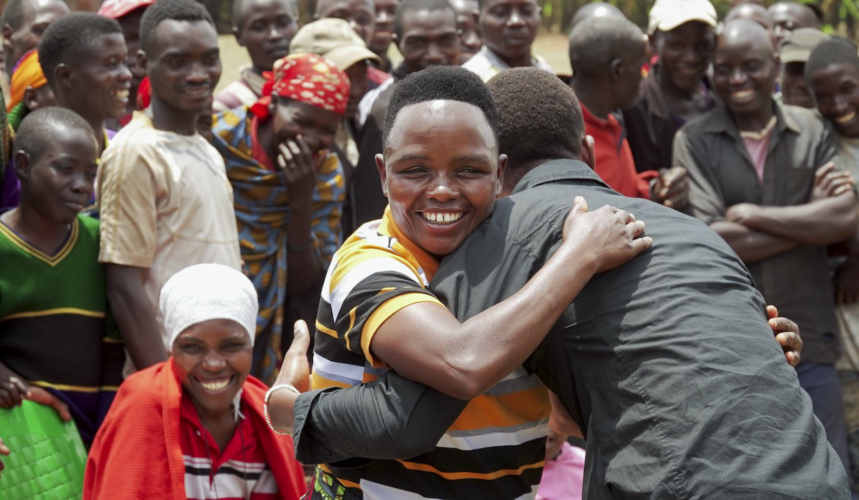
Participants to healing groups of the programme “Reinforcing community capacity for social cohesion and reconciliation through societal healing in Rwanda”.
Simply put: investors, banks, equity firms and even development finance institutions do not always have the required expertise in peacebuilding. Why not offer it to them, for the broader benefit of people, economies and societies?
Peacebuilding de-risks investment[3], for example by embedding inclusion, access, mitigating concentrations of power, and increasing accountability. It also creates what the financial world calls “additionality” – accrediting a value to benefits generated by an investment beyond its financial return.
This could be creating jobs in conflict-affected communities and distributing them equally amongst communities, empowering female-led cooperatives and business, or building a public-private partnership for access to basic public services within and beyond a factory fence. When these additionality benefits are integrated early on as peace dividends in the investment design process and with the intentional aim of building peace, this is called “Peace Finance”.
Peace Finance is a critical new way to use the tremendous core expertise of peacebuilding organisations to inform and take better, peace-aligned investment decisions that concurrently lower risks for investors and strengthen community resilience. Peace Finance has the potential to improve human development and provide dignified lives to people living in fragile and conflict-affected contexts.
A growing market and an ecosystem is evolving around Peace Finance. Organisations that are part of the United Nations such as the United Nations Development Capital Fund (UNCDF) and the Peacebuilding Support Office (PBSO), as well as peacebuilding organisation Interpeace, are working as partners to convert Peace Finance into practice.
Systemic change requires creating a Peace Finance ecosystem
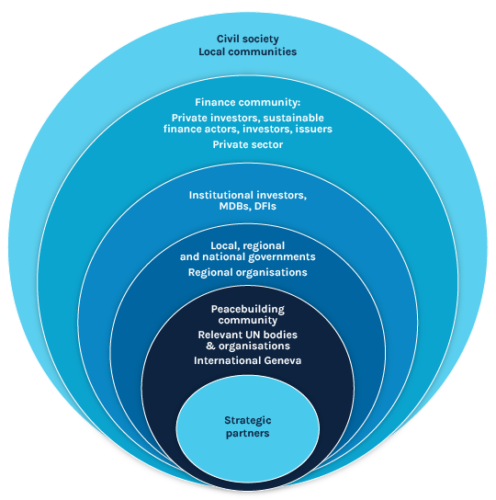
The global Peace Finance ecosystem: combining resources and knowledge for coordinated action, greater efficiency, scale and impact.
Operating within the peace-humanitarian-development nexus, UNCDF and PBSO’s Investing for Peace (I4P) and Interpeace’s Finance for Peace initiatives have received seed funding from the German Federal Foreign Office. Peace Finance is garnering interest from a rising number of Western and African governments. Among the development finance institutions, the African Development Bank is a strategic partner and global champion of this space. But governmental donors are not the only ones that are part of this new marketplace – pension funds and impact investors are also looking closely at Peace Finance, as the new emerging asset class similar to the climate and gender investment spaces. Peace Finance partnerships could indeed be paving the way for a new form of multilateralism.
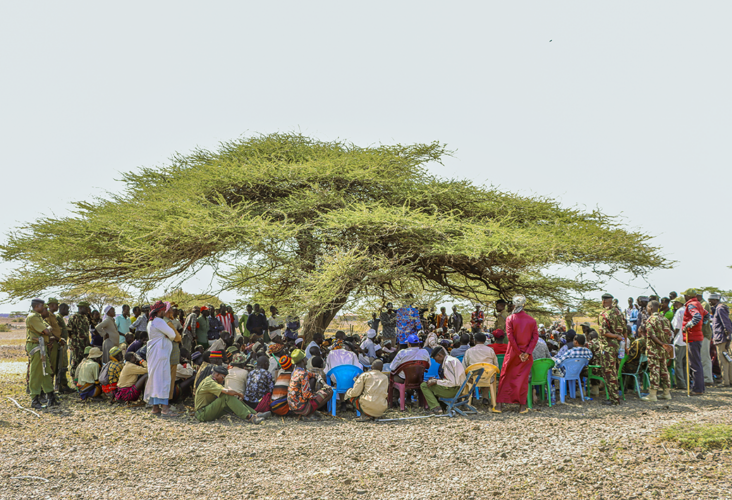
Group meeting in Kenya.
Meanwhile, it is critical to understand the importance of Peace Finance also through a conflict prevention lens, as it is being demonstrated through the Blue Peace Financing Initiative, led by UNCDF and funded by the Swiss Agency for Development and Cooperation (SDC). This initiative supports the achievement of the SDGs, while transforming water from a potential source of conflict to an instrument of cooperation and peace. It aims at creating new markets in the sustainable finance field which can cover the investment needs for local governments and transboundary basins globally, while giving riparian countries a financial incentive for cooperation around those basins, and hence for peace and sustainable development.
Critical voices may argue that peacebuilding should not be put at the service of the returns-focused private sector, which prioritises financial profits. It is not unusual for misunderstandings to arise between different sectors. However, peacebuilders, in particular, recognise the importance of inclusiveness, mutual respect, exchange, and ‘walking in the shoes of others’ to foster better understanding. Building partnerships and bridges between these worlds is essential to advancing shared goals—of which there are many—especially the common objective of building economically resilient and peaceful societies.
Like the climate space, Peace Finance needs a codified and universally agreed way of putting the methods of peacebuilders at the fingertips of the finance sector. For this reason, the Finance for Peace initiative has developed a Peace Finance Impact Framework (PFIF)[4] to guide government donors, development finance institutions, private asset managers, banks, investors and peace actors on how investment approaches can produce rigorous and benchmarked peace impacts. By bringing together core principles such as intentionality, dual materiality (benefits for investors and communities alike), inclusivity and trust, the PFIF places emphasis on a verifiable and intentional approach when achieving peace impacts.
The Finance for Peace initiative has also developed first- generation Peace Bond and Peace Equity standards[5], and has created an independent panel of peace and finance experts to advance further generations of the standards.
Implementation of the PFIF requires what the Finance for Peace initiative calls “Peace Partners”, who are actors in the ecosystem, supporting and advising private sector partners on how to put the PFIF into practice, on building trusting relationship with conflict-affected communities, or managing competing interests, for example between conflicted parties.
It is in the long-term interest of peacebuilding organisations to become active partners and advocates of Peace Finance, as it provides reliable, longer term and context-specific investment for peacebuilding. Peacebuilding organisations can apply to become Peace Partners, doing their part to ensure that investments, including projects by the private sector, are aligned with peace outcomes. There is an explicit need for the core expertise and skills of peacebuilding actors.
Peacebuilders benefit directly from Peace Finance and are indispensable actors in this new field. When aligned to the Peace Finance Impact Framework, their crucial work of conflict prevention and furthering social cohesion is financially supported from new sources of income. By championing Peace Finance among our networks together we move the needle to the next chapter of peacebuilding.
Peace is not possible without those that know the local context, and how to build, create and sustain peace in that given context: communities, peacebuilders and civil society. But peace also cannot be built without the private sector which provides livelihoods through its most important mandate: to create jobs. Let’s overcome the silos and build bridges between these sectors and actors in the interest and service of peace, which benefits us all.
Building a market for peace and a Peace Finance ecosystem is the stated mission of Interpeace’s « Finance for Peace » initiative. Finance for Peace is a multistakeholder initiative that seeks systemic change in how private and public investment supports peace in developing, fragile and conflict-affected contexts. It aims to create networked approaches that can co- develop the market frameworks, standards, political support networks, partnerships and knowledge required to scale up Peace Finance – investment that intentionally seeks to improve conditions for peace.
The UN Capital Development Fund makes public and private finance work for the poor in the world’s 46 least developed countries (LDCs). UNCDF has long experience in strengthening public and private financing systems and mechanisms, de-risking the local investment space and attracting additional finance to drive economic development in the LDCs.
As part of the Department of Political and Peacebuilding Affairs (DPPA), the Peacebuilding Support Office (PBSO) serves as a facilitator to enhance coherence and collaboration across the UN system and with partners in support of nationally owned efforts to build and sustain peace. Established in 2005, PBSO draws together expertise to advance impactful system-wide action, policies and guidance and fosters an integrated and inclusive approach to prevention and sustaining peace.
L' Investing for Peace (I4P) initiative aims to implement an approach to increase the flow of private sector investment in a way that contributes positively to peace in FCS. Understanding the complexity of the issue, I4P recognises the need for concerted partnerships (between investors, investees and affected communities) and that effective peace impact must be based on an appreciation of local conflict dynamics and the interaction between peace and private sector development in a given context.
Nous vivons en temps de guerre. Et nous semblons nous y résigner. Le nombre des conflits armés est plus élevé qu'à n'importe quel moment depuis la fin de la Seconde Guerre mondiale[1] et les dépenses mondiales en matière de défense ont progressé pour la neuvième année consécutive en 2023, atteignant 2443 milliards de dollars.[2]
Les États donnent la priorité à la puissance militaire pour faire face à des dynamiques géopolitiques et sécuritaires instables, mais leurs efforts n'ont pas réussi à mettre fin aux conflit , qui font toujours plus de victimes civiles[3] : les combats au Darfour tuent ainsi plus aujourd’hui qu’il y a 20 ans et le taux de mortalité quotidien à Gaza dépasse celui de tout autre conflit majeur de ce siècle.[4]
Et pourtant, nous savons que la violence engendre de nouvelles formes de violence et alimente les cycles de conflit sur plusieurs générations. Le retour sur investissement d’approches axées sur la guerre ne compensera jamais leur coût incommensurable en termes de vies humaines et d’infrastructures.
Selon l’Indice mondial de la paix 2023, l’impact de la violence sur l’économie mondiale s’élevait à 17 500 milliards de dollars en 2022. Or, des recherches montrent que chaque dollar investi dans la consolidation de la paix ferait diminuer de 16 dollars le coût des conflits.[5] Si nous souhaitons réellement inverser les tendances actuelles, nous devons investir de toute urgence dans le maintien et l’expansion des efforts de rétablissement et de consolidation de la paix à un niveau qui n’a pas été tenté depuis des décennies.
Par « paix », nous n’entendons pas simplement l’absence de guerre. Pour nous, la paix requière que les relations sociales, économiques et politiques soient exemptes de violence et de coercion, permettant aux communautés d’envisager un avenir sans peur ni injustice, dans la sécurité et la dignité. Y parvenir demande des ressources, un travail acharné et une solide expertise.
Nous savons que les efforts pour parvenir à la paix peuvent réussir. Nous le voyons tous les jours. Mais ils ne peuvent réussir que si nous agissons au-delà du court terme et offrons aussi des solutions aux générations futures. Ce travail ne peut réussir que si tous les acteurs de paix unissent leurs forces et cessent de rivaliser pour l’obtention de ressources de plus en plus rares. Il ne peut réussir que si les femmes sont au centre de toutes les actions de paix et ont accès à la prise de décision, et si les jeunes peuvent concevoir leurs propres solutions à leurs problèmes.
Cette époque sans précédent exige des mesures sans précédent. Lorsque les chefs d’état se réuniront au Sommet de l’avenir à New York ce mois-ci, pour adopter un Pacte pour l’Avenir et une Déclaration sur les générations futures, il faudra qu’ils déclarent d’abord sans détour leur détermination à rétablir et renforcer le dialogue et la collaboration. Ils doivent s’engager à investir massivement dans la paix pour assurer la stabilité et la sécurité de leurs peuples.
Nous devons tenir nos dirigeants responsables de chaque vie perdue ou brisée à la guerre, de chaque école ou hôpital détruit, de chaque enfant affamé par les conflits. On entend trop de discours présentant la guerre comme inévitable. Il faut au contraire mettre en avant les nombreux succès passés et actuels d’actions pour la prévention des conflits, le rétablissement et la consolidation de la paix.
Sans paix, il n’y aura pas d’avenir, pas de futures générations, pas d’avenir pour la planète. Nous lançons un appel d’urgence pour la paix.
[1]With Highest Number of Violent Conflicts Since Second World War, United Nations Must Rethink Efforts to Achieve, Sustain Peace, Speakers Tell Security Council, United Nations, Meetings Coverage, Security Council 9250th Meeting, SC/15184, 26 January 2023