Les pourparlers de paix de Genève passent au numérique en 2020

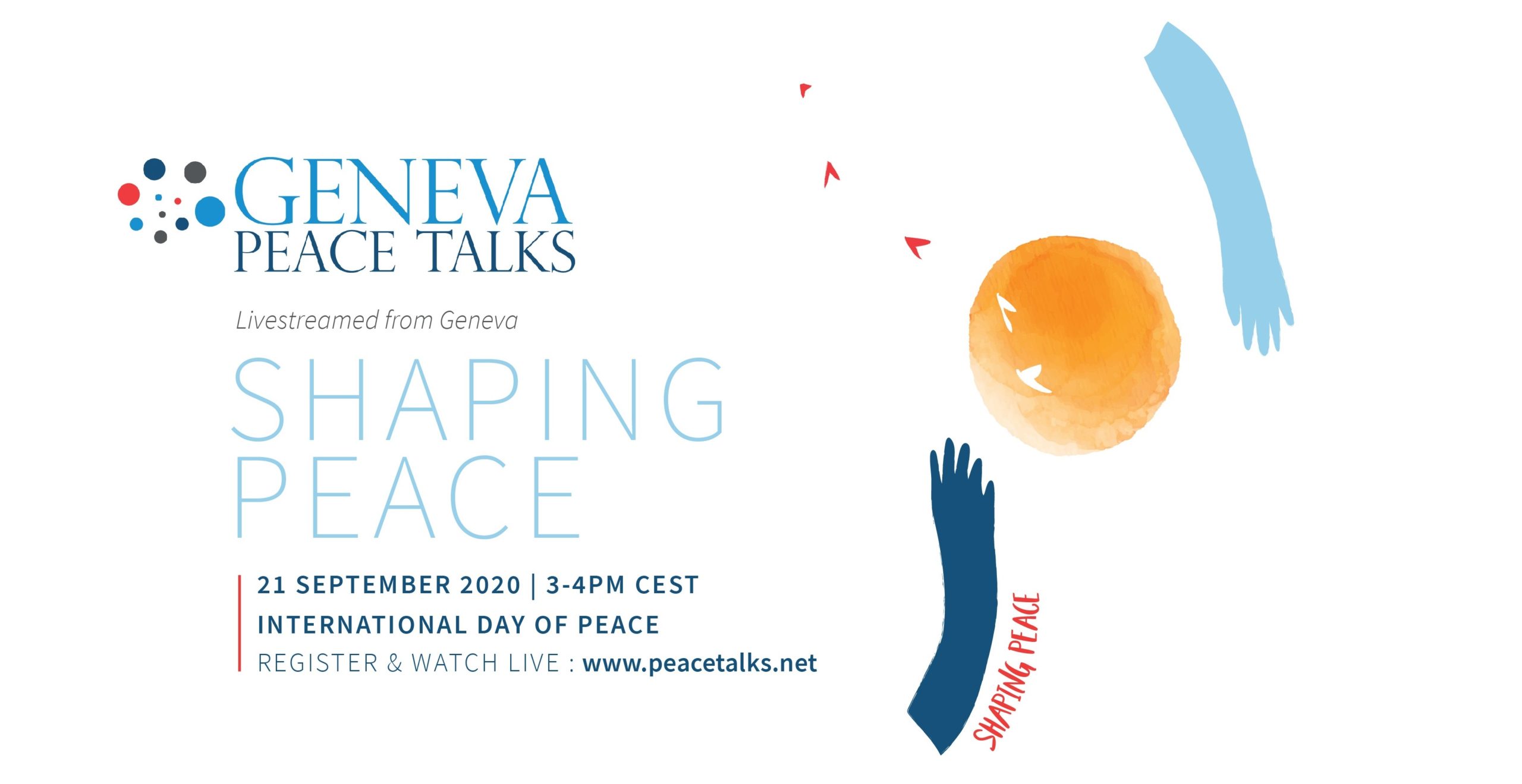
La 8e édition des pourparlers de paix de Genève se tiendra le lundi 21 septembre 2020, Journée internationale de la paix. Cette année, les pourparlers de paix de Genève passent au numérique et seront retransmis en direct depuis Genève.

Le thème central pour 2020 est Façonner la paix. En ces temps de pandémie de la COVID-19 sans précédent, les pourparlers de paix de Genève visent à mettre en évidence notre interdépendance, car ce qui se passe dans une partie de la planète a un impact sur les populations du monde entier. La pandémie a dévoilé de profonds systèmes d'inégalité, de privilège et d'injustice qui prévalent dans les sociétés du monde entier. Nous sommes maintenant mis au défi de réfléchir à la manière dont nous pouvons façonner notre monde et à ce à quoi nous voulons que notre nouvelle « normalité » ressemble.

Nos deux modérateurs vous guideront à travers de courts exposés de personnes partageant leurs histoires et expériences personnelles, afin de mettre en lumière leurs efforts pour façonner la paix.

Conférenciers 

En savoir plus sur chaque intervenant sur genevapeacetalks.ch

Inscrivez-vous ici pour la diffusion Web en direct

Rejoignez la conversation sur # PeaceTalks sur Twitter @PeaceTalksTweet, Facebook @PeaceTalks.net et Instagram @peace_talks.

Les pourparlers de paix de Genève sont un événement public organisé par l'Office des Nations Unies à Genève, Interpeace,la Plateforme de consolidation de la paix de Genève, le gouvernement suisse et Salesforce pour célébrer la Journée internationale de la paix.


RDC: Promouvoir la paix et la réconciliation au Kasaï et au Kasaï-Central

Interpeace a organisé un forum national avec ses partenaires à Kinshasa les 25 et 26 août, pour discuter des résultats et des recommandations d'une recherche-action participative menée au Kasaï et au Kasaï-Central en République démocratique du Congo (RDC).

La région du Kasaï était relativement calme, dans ce pays qui a connu de multiples conflits, jusqu'à ce que des violences éclatent en 2016 entre les militants locaux et les forces gouvernementales nationales. La région est devenue l'épicentre d'un conflit intercommunautaire qui s'est étendu aux provinces voisines. Les chiffres des Nations Unies montrent que 5 000 personnes sont mortes dans ce violent conflit qui a duré plus de deux ans et que 1,4 million d'autres ont été déplacées.

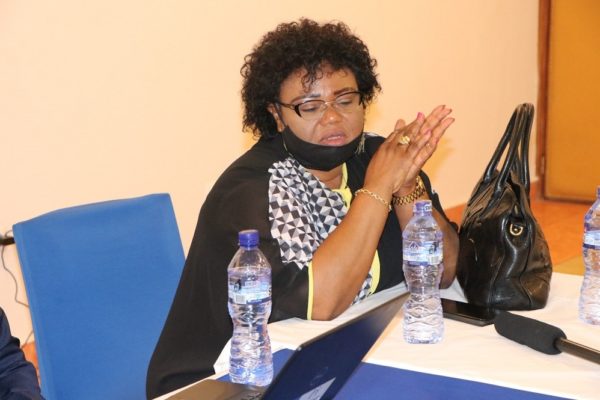
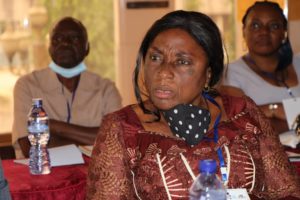
« La [rébellion] Kamuina Nsapu nous a fait souffrir. Certaines femmes ont perdu leur ferme. Elles ne savent pas où cultiver parce qu'elles ont été déplacées. Par exemple, une personne qui quitte la Kamonie et se retrouve à Tshikapa lutte pour s'intégrer », a expliqué Anne-Marie Bilambango, membre du Parlement national, au forum.

Anne Marie Bilambango, membre du Parlement national pendant le Forum. Crédit photo: Interpeace

Les tensions ethniques ont depuis lors mijoté alors que les gens luttent pour se remettre de la violence. Reconnaissant que les tensions intercommunautaires pourraient refaire surface, Interpeace et ses partenaires en RDC ont commencé à travailler avec toutes les parties prenantes pour rétablir la confiance entre les communautés de la région du Kasaï. Une partie importante de notre travail consiste à réconcilier ces communautés avec les autorités nationales et à contribuer directement à une paix durable.

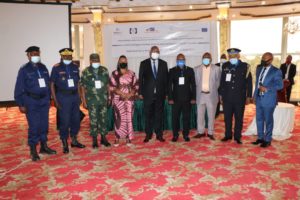
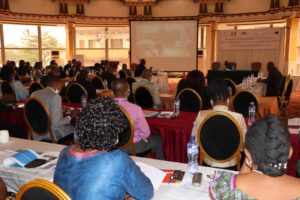
Le forum de deux jours sur la paix et la réconciliation qui s'est tenu à Kinshasa les 25 et 26 août était organisé par Interpeace et ses partenaires dans le pays, Action pour la paix et la concordance (APC), Travail et droit de l'homme (TDH) et la Commission diocésaine Justice et Paix (CDJP). Il s'inscrit dans le cadre d'une initiative de dialogue, de médiation et de réconciliation soutenue par l'Union européenne.

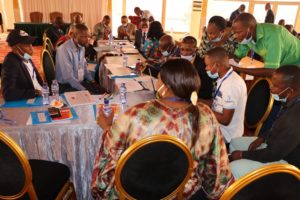
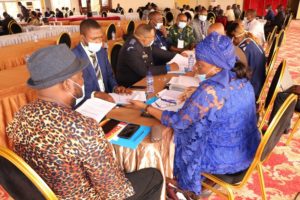
Les participants ont discuté et débattu des défis, des priorités et des opportunités pour la paix dans les provinces du Kasaï et du Kasaï-Central.

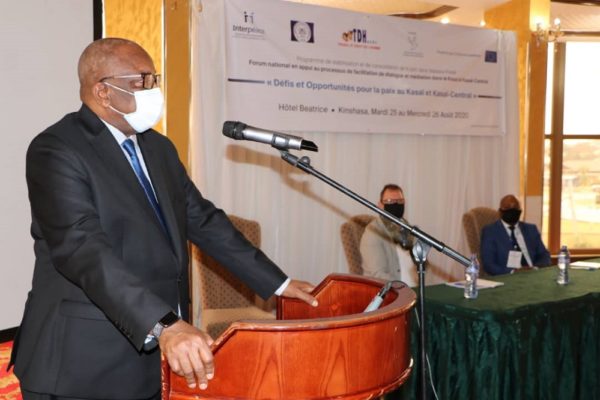
« Je suis heureux qu'il y ait des efforts pour construire et maintenir la paix au Kasaï et au Kasaï-Central aujourd'hui. J'encourage cette initiative de paix qui vise à effacer toute trace de violence perturbant la coexistence pacifique entre nos communautés », a déclaré Gilbert Kankonde Malamba, vice-premier ministre de laRDC, chargé de l'intérieur, de la sécurité et des affaires coutumières.

Gilbert Kankonde Malamba, Vice-Premier Ministre congolais, chargé de l'Intérieur, de la sécurité et des affaires coutumières, prononce le discours d'ouverture du forum. Crédit photo: Interpeace

« Nous espérons que la coexistence pacifique pourra être une priorité dans vos recommandations et apporter le calme à Mweka et Demba », a-t-il poursuivi dans son discours d'ouverture du forum.

Le forum de Kinshasa a créé une plateforme inclusive pour les participants afin de partager des idées, des expériences et des approches innovantes sur les résultats de la recherche menée par Interpeace, APC, TDH et CDJP pour la paix, la réconciliation et la cohésion sociale dans les provinces du Kasaï et du Kasaï-Central.

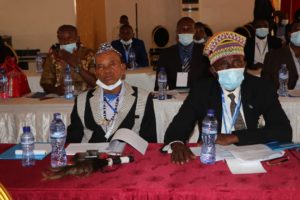
Le forum a réuni des fonctionnaires nationaux et locaux, des religieux, des représentants de la société civile, des jeunes, des femmes et des leaders communautaires, ainsi que des représentants de la communauté internationale, des universitaires, des forces de sécurité et d'autres acteurs de la paix.

« Cette réunion a été l'occasion d'un dialogue sur les défis qui ont poussé les deux provinces [Kasaï et Kasaï-Central] dans la dernière crise et sur les possibilités de construire un avenir meilleur. Ce fut également l'occasion de rétablir la confiance et la collaboration autour des engagements pris par les différents segments de la population de ces deux provinces. » a conclu Pacifique Borauzima Buluhukiro, représentant d'Interpeace en RDC.

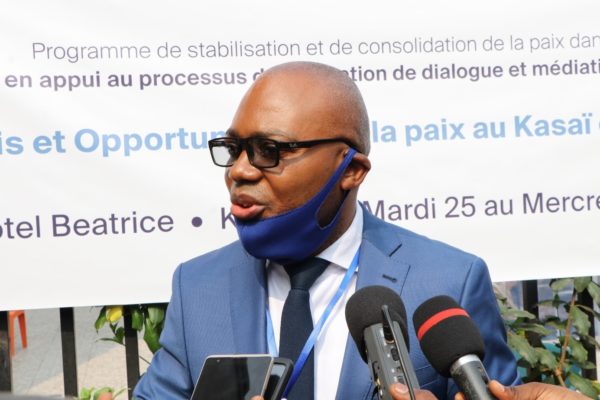
Pacifique Borauzima Buluhukiro - Interpeace Country Representative, DR Congo talking to the media at the end of the Forum. Photo credit: Interpeace

Dans les semaines à venir, Interpeace et ses partenaires continueront à engager les parties prenantes nationales et provinciales dans la mise en œuvre des recommandations clés, afin de continuer à soutenir les efforts en faveur de la cohésion sociale et d'une paix durable.


Rebuilding Trust in Mali: the Peace and Reconciliation Agreement five years on

In 2015, the Mali Government and armed groups concluded the Agreement on Peace and Reconciliation in Mali - a peace agreement to end years of violent conflict in parts of the country. Five years later, implementation of the Agreement has not progressed as expected.

According to the Monitoring Committee responsible for tracking implementation of the peace accord, none of the five pillars of the Agreement has been implemented in a satisfactory manner to date. The delay and growing mistrust increase the risk of a fresh start to violence, especially against the background of ongoing civil protests in the country.

The Agreement – resulting from the so-called “Algiers process” - was reached with the assistance of international mediators, and was a commitment to end violent confrontations, consolidate peace and enhance local participatory governance. It was signed by the Government of Mali and two coalitions of armed groups: the Coordination of Azawad Movements (CMA) and the Platform of armed groups (the Platform).

The Agreement provides the opportunity to develop locally-relevant institutional mechanisms and structures that have capacity for inclusion, active participation and social cohesion, in order to achieve not only peace but also strengthened national unity. This includes regional and local peace and reconciliation structures, a Disarmament, Demobilisation and Reintegration (DDR) programme, decentralisation measures, and the implementation of community policing to strengthen trust between communities and security actors. However, five years after the Agreement was signed, the parties are still yet to make sufficient use of the opportunity to advance the implementation of these mechanisms.
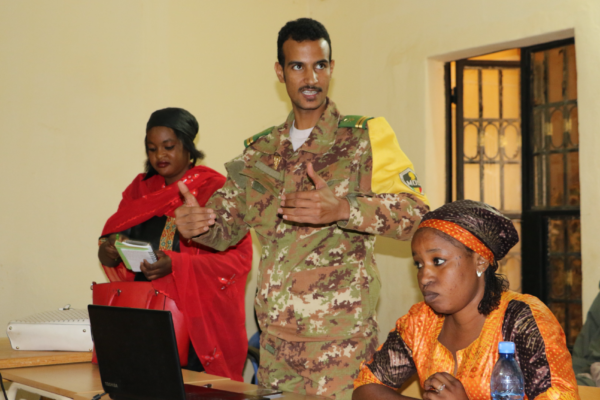
A security officer explains the mission of MOC to Gao population during a session. Photo: IMRAP

The delay demonstrates that parties need to renew their trust and commitment to achieving lasting peace.

This lack of progress so far, the challenges in implementing the Agreement and the peacebuilding need is well illustrated in the implementation of the Mixed Patrols, or what are known locally as the “MOC” (Mécanisme Opérationnel de Coordination) – a joint force that brings together the Malian army and ex-combatants from the signatory parties. The MOC is one of the pillars of the Peace Agreement, a symbol of reconciliation and a path to a future reintegrated Malian army - inclusive of all formerly conflicting parties. However, the MOC is struggling to gain the trust of local populations amidst a climate of heightened fear, tensions, and insecurity.

To increase trust and collaboration between the MOC and the populations of Gao and Timbuktu, Interpeace and its local partner in Mali, the Institute Malien de Recherche Action pour la Paix (IMRAP), have supported the creation of a collaboration framework between the MOC and civilians.

“The best solution are these meetings (…) that you organise, to be able to calm and lower tensions before it is too late, and to create a climate of trust between the MOC and the civilian population,” said one participant during a dialogue session facilitated by IMRAP in Timbuktu.

Through participatory dialogue and joint and localised activities in Gao, the MOC and local populations have gained a deeper and stronger understanding of their roles and responsibilities in building peaceful societies.

“The MOC was perceived as the cause for trouble in Gao and their camps were seen as a source of security problems. Acts of banditry perpetrated in the towns were attributed to the MOC. Crimes committed with pick-up vehicles were directly attributed to the MOC because their cars were not labeled for identification,” said Alban Tapsoba, Interpeace’s Programme Support Officer in Mali.

He added: “Our intervention made it possible to brand and identify MOC vehicles. The populations are the first to defend the MOC now, when criminal acts or abuses are committed with vehicles not owned by the MOC.”
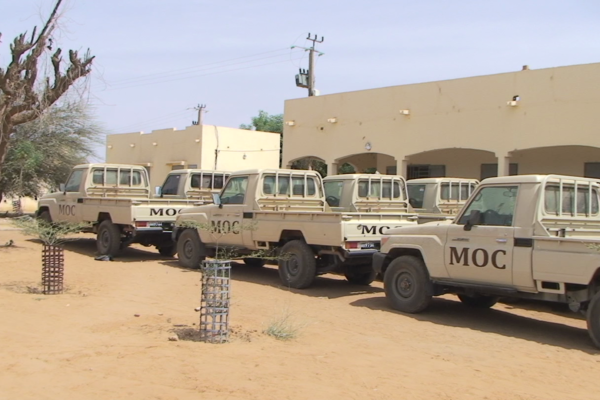
Branded MOC vehicles. Photo: IMRAP

Radio discussions, video projections, debates, and awareness campaigns with community leaders, youth and communities have contributed to enhancing trust and social cohesion. Interpeace’s programme has also facilitated exchange workshops between the MOC and communities, leading to the implementation of community projects, designed and implemented by communities and the MOC themselves. Support to localised solutions is key to sustainability and ownership. These actions, which promote reconciliation - an important part of the Agreement - also contribute to prevention efforts in the North of Mali.

“Next time we meet with the MOC, we are going to share a meal together. We are going to eat together. We are going to spend the day together. It will no longer be from group to group, but from person to person,” explained a participant at one of the dialogue meetings in Gao, facilitated by IMRAP.
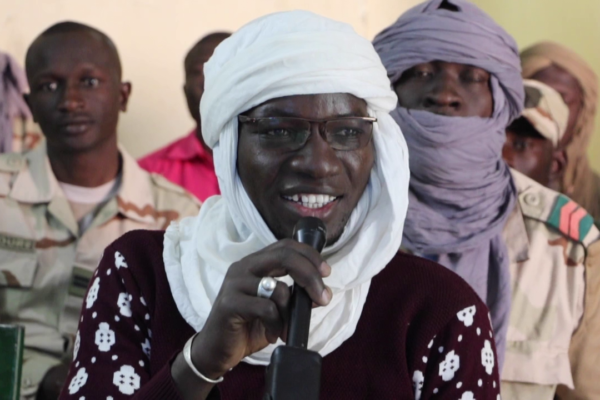
A participant speaks during dialogue session between the MOC and communities in Timbuktu. Photo: IMRAP

Since 2016 Interpeace and IMRAP have been working with local and international stakeholders and supporters to contribute to an inclusive and participatory implementation of the Peace Agreement with support from the Peace and Stabilization Operations Programme of the Government of Canada as well as the UN Peacebuilding Fund.

“The general conclusion is that there has not been as much progress over the last five years as all parties hoped would be possible and planned. But implementing peace agreements anywhere in the world is always harder than negotiating and signing them in the first place. And, thanks to dedicated and locally-adapted action on the ground, continued commitment by the Government of Mali, and long-term support from international partners, there is the opportunity to make further progress in the years ahead on all elements of the Peace Agreement.” said Simon Gimson, Interpeace’s Vice-President.

Crucially, trust is being successfully rebuilt, which is an investment in the Agreement’s and Mali’s future,” he concluded.
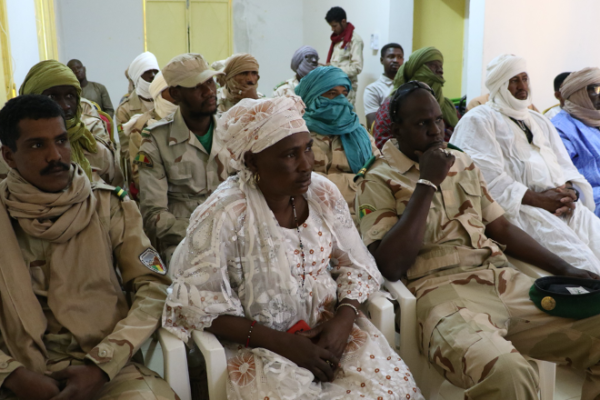
MOC security officers and civilians during a dialogue session in Timbuktu. Photo: IMRAP
UN Security Council gives a welcome boost to Youth, Peace and Security

The United Nations Security Council has adopted its third resolution on Youth, Peace and Security (YPS): UNSCR 2535. It signals the Security Council’s determination to drive forward practical action on YPS, and to do so in an integrated and coordinated way across the United Nations system as a whole.

There are still troubling indications that young people are seen as a ‘problem’ at risk of being radicalised and caught up in security challenges worldwide. The challenge now is to ensure that the Security Council’s political will is converted with resources and actions into effective implementation and delivery.

Interpeace was active in the lead-up to UNSC 2535 and is developing initiatives to support its implementation. Interpeace will also be publishing policy and practice briefings on YPS that are co-authored with young peacebuilders.

Crédits photo : CENAP

Co-sponsored by the Dominican Republic and France, the new UN Security Council Resolution (UNSCR) 2535 on Youth, Peace and Security (YPS) is the third and also the most action-oriented YPS resolution adopted by the UN Security Council so far. The Resolution provides guidance for the implementation of the YPS agenda both at the country and headquarters level in the UN system. The Resolution raises the bar in five key ways, which have been analysed in this briefing paper. In sum:

First, UNSCR 2535 cements the priority of the YPS in the UN by requiring joined-up action across the operational siloes across the UN, requiring the UN Secretary-General to submit biennial reports on the implementation YPS agenda, and requiring YPS thus to appear regularly on the Security Council’s agenda. This ensures that action will occur and that there will be accountability and transparency across the UN system.

Secondly, UNSCR 2535 reasserts and tightens the relationship between the global YPS agenda and the ‘Sustaining Peace’ agenda, and also consolidates connections with the ‘Women, Peace and Security’ agenda including a repeated commitment to the distinct experiences and roles of young women.

Thirdly, UNSCR 2535 recognises the demographic of youth through a peacebuilding lens and offers a powerful – and essential – vehicle to integrate peacebuilding and prevention efforts across all phases of peace and conflict cycles, not just in post-conflict contexts.

Fourth, UNSCR 2535 introduces new political commitments through its emphasis on meaningful participation of youth. This also goes beyond formally mediated peace processes, by acknowledging the value of youth participation in post-conflict humanitarian context including reconstruction, rehabilitation and recovery effort as well as in reconciliation processes. This builds positively on the two previous Security Resolutions on YPS (UNSCR 2250 of 2015 and UNSCR 2419 of 2018).

Fifthly, and perhaps of greatest significance, UNSCR 2535 recognises for the first time, “the structural barriers that limit the participation and capacity of young people”, acknowledging that this particularly impacts young women. It makes a reference to “protecting civic and political space” where young people can legitimately and freely express themselves, which is arguably precedent-setting in bridging the peace and security, and human rights pillars of the UN.

Finally, though, UNSCR 2535 also restores the problematic reference to the threat of youth radicalisation that had been excised from the earlier UNSCR 2419, as well as from the recent Presidential Statement which was adopted following the open debate organised by South Africa on “Youth Silencing the Guns by 2020”. In this respect, Resolution 2535 runs the risk of reinforcing the policy panic on youth and violent extremism and the ‘securitisation’ of the YPS agenda.

Photo Credit: Interpeace.

The concern about young people and extremist forms of violence can only be addressed satisfactorily when meaningful efforts are made to counter the “violence of exclusion” of young people.This sentiment was expressed by young people themselves in the “Missing Peace: Independent Progress Study on Youth, Peace and Security” report. Specifically through its reference to the United Nations Youth 2030 Strategy of the Secretary-General, the Resolution calls on governments to invest in the resilience, resourcefulness and inclusion of young people to build peace, rather than in risk-based approaches which project young people as a potential threat, alienate them, close down their arenas of political participation, and inhibit their engagement in peacebuilding.

Next Steps

As a practical follow-up to this Resolution, Interpeace plans to develop initiatives to support the implementation of UNSCR 2535, including in the areas of education for resilience; deepening young people’s participation in peace processes; developing youth-oriented ‘peace responsive’ peacebuilding programmes in the field; and, engaging in YPS through the intersection between peacebuilding and human rights.

In anticipation of the 5th Anniversary of UNSCR 2250 (the first ever Resolution on YPS), Interpeace will also produce a series of new policy and practice briefs co-authored by and amplifying the voices of young peacebuilders themselves. These policy and practice briefs will be published on this website in the coming months.

Click Cliquez ici to read the full analysis.

Why Peacebuilding should be part of the COVID-19 response

COVID-19 has taken the world by surprise and upended life as we know it, introducing looming uncertainties. As we unite in fighting the rapid spread of the virus, we must also recognize that the consequences of the pandemic go beyond medical and public health. The crisis is unique because the direct solutions and ameliorative public health approaches have the potential to be highly conflict-inducing. Thus, the integration of peacebuilding approaches into international responses to COVID-19 is now a matter of urgency.

This briefing paper, Peace and Conflict in a COVID-19 World – Implications for International Responses, summarises ten framing aspects of the crisis and offers three implications for international actors responding to it. Our collective understanding of the causes and solutions to the crisis will determine how we respond to the crisis. While much is uncertain, it is clear COVID-19 is both a multidimensional crisis and an opportunity for change. The key question before us all — especially local and international humanitarian, development, and peacebuilding actors — is how to leverage opportunities for positive change and manage the potential risks?

It is clear human-centred and cooperative approaches which are at the core of peacebuilding work are needed. Peacebuilding approaches of local ownership and leadership with a long-term resilience focus are critical to embed into technical health responses, as well as broader socioeconomic responses to COVID-19. The way in which these approaches are integrated into national and international responses will be critical not only for the technical success of those responses, but also to understand whether they support peace or might exacerbate new or existing grievances already triggered by the pandemic.

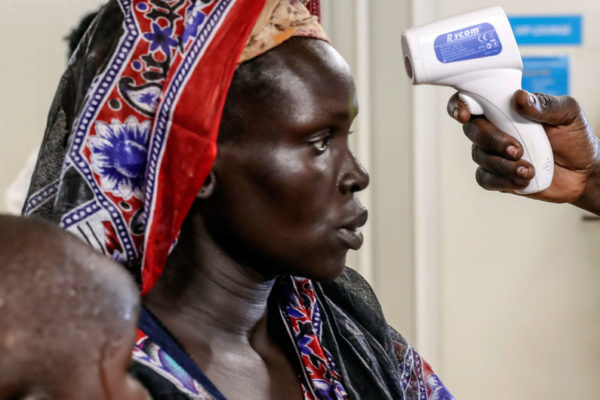
Photo Credit: UN/ Isaac Billy

Early in the crisis some referred to the pandemic as a “great equalizer,” but as the disease evolves, it is increasingly apparent that it is anything but equalizing. COVID-19 threatens broader peace and stability by exacerbating persistent political, social, and economic structural inequalities that render some groups more vulnerable than others. In many contexts, it is reinforcing patterns of inequality and grievances that erode the social contract between individuals and communities with the states that represent, govern, and protect them.

We need resilience approaches that can enhance positive local capacities, skills, and attributes, and enable communities to not just ‘bounce back’ but ‘build back better.’ These conflict sensitive, locally owned, and peace responsive peacebuilding approaches are highly cost-effective and sustainable. They must not be sacrificed due to short-term reallocation of funds to what is deemed as “immediate” pandemic responses. Short- and long-term responses to COVID-19 must be aligned.

Thus, the question of how peacebuilding approaches are integrated into the multidimensional humanitarian and development actions of governments, INGOs and UN actors — or not — is not theoretical. The extent to which international humanitarian and development responses are conflict sensitive and peace responsive to the direct and indirect impacts of COVID-19 will be critical in determining how successfully those interventions contain the virus. The opportunity for transforming conflict dynamics and patterns of structural violence in this moment is significant and can be driven through operational peace responsive approaches.

As a next step to this briefing paper, Interpeace is developing recommendations and practical actions both for its own peacebuilding policy and programming and to inform the policy, programming and coordination of other international peacebuilding actors. They will be published on this website in the coming months.

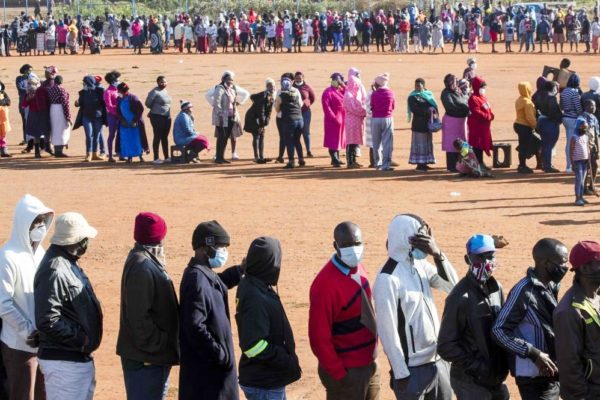
Photo Credit: AP Photo/Themba Hadebe

Read the full briefing paper: Cliquez ici 

Interpeace’s Commitment to Diversity and Inclusion

The tragic death of George Floyd in the United States has affected all Interpeace staff worldwide in a profound way. It is an affront to human dignity and human rights, and thus to Interpeace’s values and principles.

L' Black Lives Matter protests are a global clarion call for a long overdue reckoning with systemic racism against black communities and people of colour.

Interpeace unequivocally condemns racism and is committed to using its resources to address racism in all its manifestations. We affirm our full support to those seeking to change peacefully the patterns of racial injustice that have led to the perpetuation of physical, structural, and cultural violence around the world.

The corrosive legacy of colonialism, anti-black racism and xenophobia continues to have an influence and impact on peacebuilding work today and cannot be ignored. If the world is to achieve meaningful and sustainable peace, there must be recognition of the inter-generational traumas - past and present - caused by centuries of bias, privilege, inequality, and injustice and of how these factors determine life outcomes today.

Racism comes not only in open and direct forms, but in everyday experiences of unconscious bias and discriminatory behaviour. We must therefore be equally vigilant in addressing overt and covert or casual forms of racism and prejudice in our societies.

When the social contract is repeatedly violated, especially by security forces, then public protest and dissent are an understandable and almost inevitable response. Often, such demonstrations are the only way that society is able to shine light on its own patterns, behaviours and institutions of exclusion. In this way, social protest movements become an essential part of the process of restoring trust and building a better future.


Photo credit: Interpeace.

As an international organization for peacebuilding, Interpeace recognizes its responsibility to advance equality and eliminate all forms of discrimination within its structures as a pre-requisite to supporting and enabling local communities to transform their own conflict dynamics. This has led us to consult internally on the need to establish a process of self-examination and reflection to ensure that no form of discrimination, intolerance, or exclusion on racial or other grounds can take place within our own organization.

To advance this commitment, Interpeace is establishing a representative Diversity and Inclusion Working Group that will independently consult with all staff, and will support management to (1) foster a constructive and inclusive discussion in the organization about diversity and inclusion; (2) identify ways, where required, to eliminate any structural, systemic or casual forms of racial and other discrimination and exclusion within our organization and networks; (3) review and offer recommendations on ways to enhance our peacebuilding work positively and meaningfully in support of greater diversity and inclusion; and, (4) strategize how to scale up Interpeace’s practical support for peacebuilding, including in Europe and the U.S., that addresses exclusion, racism, and marginalization.

Interpeace will also join other peacebuilding organizations wherever possible to create greater collective effort and progress in advancing and upholding diversity and inclusion in the worldwide peacebuilding community.

Interpeace takes these steps to build a stronger and more diverse and inclusive organization that is better able to address structural and systemic patterns of exclusion wherever they may be present.


Scott M. Weber

Président

Interpeace